Showing posts with label Academies. Show all posts

Tuesday, 18 May 2021

Organise to oppose Williamson’s academisation plans

In April, Education Secretary Gavin Williamson announced that he wants all schools to become academies. While educators have rightly learned to treat Williamson’s ill-considered pronouncements with disdain, it was nevertheless a warning that this Government still plans to push further towards doing away entirely with any kind of democratic local control over education through elected Local Authorities.

A push for further academisation by Ministers risks more Governing Bodies wondering if they should ‘jump before they are pushed’ into joining a Multi Academy Trust, particularly if the Labour Party’s previously firmer opposition to academisation weakens under its new leadership. 

Meanwhile, the legislation that forces unwanted academisation onto schools deemed to have been ‘failed’ by Ofsted will continue to do its damage.  But the tenacious struggle by staff and parents at Moulsecoomb Primary in Brighton to defend their community status shows how firm opposition can  – and must – be built and given our full support.

Instead of allowing further academisation, educators, parents and unions need to step up our calls for an end to academisation and for the return of schools to genuine democratic local control where they can work together in meaningful partnership, funded to fully meet needs, and with all staff employed under national agreed pay and conditions.

Hands Off Moulsecoomb Primary School

5 reasons to oppose an academy transfer:

1. Becoming an academy doesn’t improve educational attainment 

The academisation of schools has been just one aspect of a global drive to break-up state education and impose an education market of competing chains of schools. In England, Ofsted, SATs and exam league tables have been the weapons used to unfairly grade and compare both schools and school students, creating a culture of ‘failure’, instead of genuine school improvement. 

Aside from the right-wing ideologues that believe in the magical powers of the ‘market’, it will come as no surprise to most people that the research evidence has consistently shown that academisation does NOT result in improved educational attainment. 

The results of a four-year evaluation published by researchers at the UCL Institute of Education in 2018 concluded that “there is no positive impact on the attainment and progress scores of pupils in MATs when compared to equivalent non-MAT schools”. It also noted that “pupils in larger MATs did worse, particularly in secondary schools”.

The research also pointed out the damaging effect of the marketisation of schools on education as a whole: “Schools are facing pressure to get good exam results and Ofsted grades, or face being taken over by a MAT. Many schools have felt the need to narrow their curriculum and focus relentlessly on test outcomes in response”.

Research from the Education Policy Institute has found similar findings. Their comparison of school performance across every trust and local authority in England in 2017 found “little difference in the performance of schools in academy chains and local authorities” overall.  

The Education Policy Institute’s analysis of primary school results also noted that while “Local authorities make up 15 of the top 20 school groups at Key Stage 2 … academy chains are over-represented in the lowest performing groups”. 

This mirrors the findings of the House of Commons Education Committee that “We have been unable to locate any evidence ... of a relationship between primary academy status and raised attainment”.

2. Academisation and the ‘market’ in education have increased inequality

Instead of encouraging genuine school improvement, through sharing of good practice, reduced workload, better training and support, and funding to meet needs, the marketisation of schools has done the opposite. 

The pressure of league tables and Ofsted gradings has encouraged schools to ‘game the system’, changing their intake to improve results at the expense of their ‘competitors’, rather than genuinely improving education for all. Research has shown that Multi-Academy Trusts have particularly failed to meet the needs of disadvantaged pupils.  

Fragmentation, and the undermining of national pay and conditions and facility time arrangements through academisation, has also increased inequality for staff as well.

The marketisation of education has to be reversed, including reversing academisation.

The authors of the 2018 UCL Institute of Education research spelt out what is happening: 

“The system is hard-wired to encourage selfish behaviour, because the consequences for schools of a drop in exam scores or Ofsted grade can be so catastrophic. At present we see a chaotic system of winners and losers, with increasing incoherence and a loss of equity as a result” 

"Lower-status schools frequently face a concentration of challenges including under-subscription, movement of pupils throughout the school year and disproportionate numbers of disadvantaged and hard to place children. These schools were also most likely to report a negative impact as a result of austerity cuts to wider local services for the most vulnerable children, previously provided by local authorities."

Research from the Sutton Trust concludes that “Two-thirds of academy chains perform below the national average for all state schools on key measures of attainment for disadvantaged young people.  Improving their educational achievement was [supposedly - MPD!] the original reason why academies were set up.  In this regard they have not succeeded”.

The British Journal of Sociology also found that academies are more likely than other schools to employ teachers who are unqualified. “The greatest increases are among those structured more like businesses — academies run by government-approved sponsors or belonging to a chain of schools”.

Pay inequality for staff working in academies is also consistently shown in the Government’s school workforce data. The latest Government report confirms that “Average salaries for classroom and other leadership teachers are higher on average in LA maintained schools than academies”. However, pay inequality is also greater within academies too. The school workforce report also notes that: “The average salary for headteachers is however, higher in academies than in LA maintained schools”. 

Of course, MATs have not just been spending their budgets on increasing Headteacher pay. Schools Week have dubbed the extortionate top salaries in some MATs as an “emerging ‘super league’ of academy trust CEO pay”. Here is their “top ten”:

Figures from Schools Week

3. Becoming an academy will not protect your school from budget cuts

Just as in the NHS, imposing a market on schools was supposedly meant to improve ‘efficiency’. The lack of accountability that comes with privatisation instead risks spending being diverted to cronyism and pay rises for those at the top.

But, overall, the break-up of state education has been a mechanism to cheapen the cost of education, both by making it easier to cut the Local Authority services that schools used to be able to rely on, and by driving down staffing costs. That’s because the fragmentation of education into so many different employers has helped to weaken trade union organisation and to undermine nationally agreed pay and conditions.

While, in the initial drive to encourage academy transfers under Tony Blair, financial incentives were provided to encourage schools to convert, academisation is certainly no longer a way for governors to protect themselves from budget cuts. In fact, without the support of a Local Authority, an academy leaves itself more exposed. The most recent National Audit Office report into schools’ financial sustainability – last compiled in 2016 – confirmed that a greater proportion of academies were running annual deficits than local authority maintained schools:

Criticism over the extent of “related-party transactions” being carried out by academies - payments to individuals or organisations with which senior staff have relationships – led to a tightening of Government regulations. But, without genuine democratic oversight, the issue is not going to go away. 

For example, the TES reported on one expanding Multi Academy Trust based in Wakefield spending nearly £40,000 on related-party transactions in 2018/19 alone.

4. Being an academy doesn’t increase educational ‘freedom’

Academisation was sold to schools as a way of giving them ‘freedom’ from the ‘bureaucracy’ of a Local Authority. Certainly, when schools are returned to   local democratic control, it must also be done in a way that ensures there is a genuine voice for schools, staff, parents, unions and the wider community. For example, the recent proposals from the Socialist Education Association call for an elected education committee or board.

In reality, academisation has provided no genuine ‘freedom’ at all. Instead it has allowed greater Government centralisation and the growth of unaccountable Multi Academy Trusts where parent, staff and student voices are rarely heard.

Once converted, schools become a commodity that can be transferred from one MAT business to another without their say.

Supporters of academisation continue to argue that MATs can just takeover the roles that Local Authorities used to provide, including the educational partnerships and collaboration needed for genuine school improvement.

But, as the 2020 UCL research quoted above puts it: “MATs are commonly referred to as a form of partnership, but we argue that this is inappropriate … We argue MATs are best understood in terms of ‘mergers and acquisitions’, with prescribed models of governance and leadership largely derived from the private and, to a lesser extent, voluntary sectors”.

Those models of governance leave key decisions in the hands of a small Trust Board. Individual school governing bodies within a Trust have little power, if, indeed, they are allowed to exist at all by the MAT.  

As a 2019 House of Commons Public Accounts Committee report explained “Parents and local people have to fight to obtain even basic information about their children’s schools, and academy trusts do not do enough to communicate and explain decisions that affect the schools they are responsible for and how they are spending public money.”

But if parents and Governors want to change their mind and return to Local Authority maintained status, it’s too late. The current legislation means that a decision to become an academy is irreversible. What’s more, once that transfer has happened, the Government is entitled to then transfer a school to a new Trust, without any further say by staff, parents and Governors. Over a thousand academies have been ‘re-brokered’ to new trusts in the last five years.

And, of course, the tendency is towards ‘monopoly’ – with smaller MATs being taken over by a few larger corporate MATs who would then dominate public education without any real democratic oversight.

5. Schools will do far better in partnerships without becoming academies

The real solution to ending the chaotic and damaging fragmentation of state education in England is to return all schools to democratic local control. But, until then, remaining maintained schools need to resist the pressure to convert and develop their own school partnerships instead.

While educational research continues to show that the academisation is failing education, it also shows that what really works is genuine partnership between local schools within a Local Authority.

For example, the successful school improvement initiatives around the London Challenge from 2003-2011 were based on local support for teaching and learning, not academisation. 

Some groups of schools are working well in partnerships as local authority schools. 

For example, in response to Gavin Williamson’s announcement in April, Harry Kutty, Chair of the Aspire Community Trust, a group of maintained schools in Southampton, tweeted “It’s not all about MATs. It’s about collaboration, culture and a pursuit of the very best experience and outcomes for all. Suggesting that only MATs can create systems around these principles is simply not true”.

Of course, if Local Authority services and education budgets continue to be cut, then the resources needed to meet all students’ needs, and to develop genuine partnership and school improvement, will be even harder to find. That’s why, in opposing academisation, we also have to fight for education funding and oppose cuts to local authority services.

We must make clear that academisation doesn’t provide any way forward. In fact, it is part of a deliberate strategy to help governments drive down the costs of education. Instead, we have to organise to defend all schools fighting academisation and demand a return of all schools to democratic local control, funded to meet the needs of all.

You can download this post as a 4-page A4 leaflet here.


And visit my Martin4DGS campaign website for further information here.


Friday, 27 September 2019

Labour votes to abolish academies and private schools


This article was written for - and published - in The Socialist newspaper, 25 September 2019 . I would also add that Labour also need to make clear to staff working in independent schools that their jobs and livelihoods would be protected in the transition to private schools becoming part of the state sector.

John McDonnell and Jeremy Corbyn march with teachers and striking doctors, photo Paul Mattsson


Angela Rayner, Shadow Education Secretary, announced at her party's conference that a Labour government will abolish tuition fees, provide free nursery education for all two to four year olds, cap the cost of school uniforms and end the hated Ofsted inspection regime.


These promises alone could help enthuse young voters, parents and school staff into campaigning to elect Jeremy Corbyn. But conference went further still.


Rayner had been far less clear about how Labour's promised 'National Education Service' would include private and academy schools. However, delegates voted for motions that called for a complete end to both of them!


The growth of academies was supported by both the Tories and Blair's 'New Labour'. It represented a conscious attempt to create a market of competing chains of schools, making it easier to slash education spending, especially on central services previously provided by local authorities, and to undermine national pay and conditions for school staff.


Nearly half of England's pupils now attend academy schools, run by a chaotic array of hundreds of different 'multi academy trusts'. Of course, they haven't improved education - only the bank balances of those who control them.


The evidence about the failings of the academy model has been growing, along with many vociferous local campaigns against them. Yet too many Labour councils have failed to oppose academisation.

Local authority control

The successful motion called for all publicly funded schools to be under the control of their local authority through "reformed, democratically accountable local education committees with stakeholder representation".


This could, if developed fully, allow genuine democratic control of schools through elected representatives of the local community, parents, trade unions and school students.


The motion stated that the committees must be "the default providers of services and appropriately funded". Reversal of education cuts will certainly be vital to allow all children and schools to thrive, supported through central services that can make sure all needs are met.


Labour conference also voted to remove private schools' phoney 'charitable status', to redistribute their wealth to state education institutions, and for a quota that would only allow universities to admit the same proportion of private school students as in the wider population. That's only 7% - but they make up around 40% of successful Oxbridge entrants.


Britain's wealthy have never had to worry themselves about the pressures on state schools. For them, the existence of a separate system of elite private education has allowed them to buy schooling for their children providing far smaller class sizes and a wider curriculum than the increasingly narrow diet enforced on working-class youth.


As austerity bites, the proportion of pupils from state schools attending university has started to fall, particularly in the top 'Russell Group' institutions.


Of course, the wealthy will not allow any of their privileges, educational or otherwise, to simply be voted out of existence. However, the fact that Labour delegates supported the motion is a reflection of the huge anger against growing inequality in society, not just in education but in our workplaces and communities.


If Corbyn can convince workers that he understands that anger, and has a programme to address it, then the Tories can be thrown out of office.

Tuesday, 8 May 2018

Avenue School Governors withdraw plans for academy transfer

NEU STATEMENT, 8 MAY 2018:  AVENUE SCHOOL (NEWHAM) GOVERNORS WITHDRAW THEIR PLANS TO CONVERT TO ACADEMY STATUS

Front-page news in the latest copy of 'The Teacher'

The Governing Body of Avenue Primary School has confirmed that, at its meeting last Thursday, it took a decision NOT to move forward with plans to convert the school to academy status.

Martin Powell-Davies, London Regional Secretary, who spoke to the Governors’ meeting, said:

Staff and parents will be delighted to hear that, after a campaign that included nineteen days of strike action to oppose academy transfer, members of the National Education Union can now end their strikes, knowing that Avenue Primary is going to remain a community school.

The NEU would like to thank Avenue Governors for reaching this decision and all in the school community who took part in the vibrant campaign to oppose Avenue becoming an academy. 


The lively rallies on the school gates on strike days, always supported by dozens of local parents, left Governors in no doubt that the campaign showed no signs of weakening. The determination and unity across the school community shown at Avenue School over the last six months of action will be an inspiration to other campaigns organising to stop academisation in their schools. 

Unity was forged around the demand for a binding ballot of staff and parents to decide on academy transfer. The NEU offered to halt its strikes if such a ballot was agreed and proposed that meetings were held, and information circulated in community languages, so that parents could fully participate in deciding on the future of their school. Those demands should now be taken up by parents & staff of other schools to ensure genuine consultation over academisation.

Governors at Avenue must have known that the mounting evidence exposing academisation would mean a genuine debate could only reach one conclusion – to oppose transfer – and simply decided to withdraw their plans altogether. The energy and unity shown by both staff and parents in the campaign can now help Avenue School to further support children’s education. If there is any future attempt to revisit academisation, then the opposition will be even stronger!

The National Education Union made clear that we opposed academisation at Avenue because it would damage education and transfer the School to an unaccountable Multi Academy Trust. As a community school, parents will continue to be able to call on an elected Council for support. 


The Avenue campaign helped convince Newham councillors when they voted in February to oppose academisation and to support the call for staff and parental ballots. The NEU looks forward to working with Newham’s newly elected Mayor, Rokhsana Fiaz, in developing plans to support Newham schools, including through developing partnership arrangements that avoid the unnecessary educational risk and fragmentation that academisation inflicts on local schooling.

The NEU congratulates its members on their successful action. Their campaign, alongside others being organised across London, is turning the tide of public opinion against academisation.” 

Download the NEU statement here

Friday, 29 December 2017

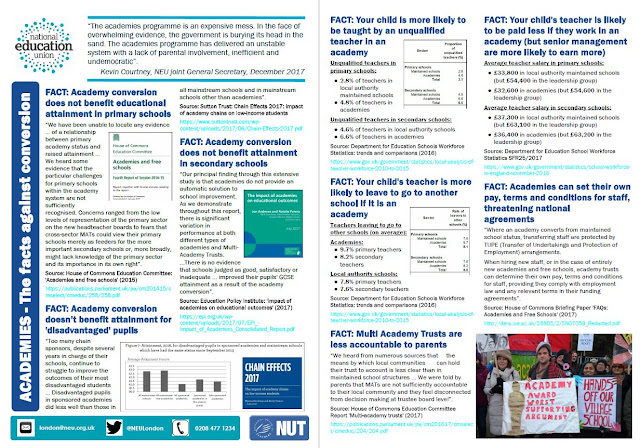
Academies - the facts against conversion


https://goo.gl/jHtqAA

“The academies programme is an expensive mess. In the face of overwhelming evidence, the government is burying its head in the sand. The academies programme has delivered an unstable system with a lack of parental involvement, inefficient and undemocratic”.
Kevin Courtney, NEU joint General Secretary, December 2017

FACT: Academy conversion does not benefit educational attainment in primary schools

“We have been unable to locate any evidence ... of a relationship between primary academy status and raised attainment ... We heard some evidence that the particular challenges for primary schools within the academy system are not sufficiently recognised. Concerns ranged from the low levels of representation of the primary sector on the new headteacher boards to fears that cross-sector MATs could view their primary schools merely as feeders for the more important secondary schools or, more broadly, might lack knowledge of the primary sector and its importance in its own right”.
Source: House of Commons Education Committee: 'Academies and free schools' (2015)
https://publications.parliament.uk/pa/cm201415/cmselect/cmeduc/258/258.pdf


FACT: Academy conversion doesn’t benefit attainment for 'disadvantaged' pupils


“Too many chain sponsors, despite several years in charge of their schools, continue to struggle to improve the outcomes of their most disadvantaged students ... Disadvantaged pupils in sponsored academies did less well than those in all mainstream schools and in mainstream schools other than academies”.
Source: Sutton Trust: Chain Effects 2017: impact of academy chains on low-income students
https://www.suttontrust.com/wp-content/uploads/2017/06/Chain-Effects-2017.pdf


FACT: Academy conversion does not benefit attainment in secondary schools


“Our principal finding through this extensive study is that academies do not provide an automatic solution to school improvement. As we demonstrate throughout this report, there is significant variation in performance at both different types of academies and Multi-Academy Trusts. ...There is no evidence that schools judged as good, satisfactory or inadequate ... improved their pupils' GCSE attainment as a result of the academy conversion”. 
Source: Education Policy Institute: 'Impact of academies on educational outcomes' (2017)
https://epi.org.uk/wp-content/uploads/2017/07/EPI_-Impact_of_Academies_Consolidated_Report.pdf


FACT: Your child is more likely to be taught by an unqualified teacher in an academy


Unqualified teachers in primary schools:
2.8% of teachers in local authority maintained schools
4.8% of teachers in academies
Unqualified teachers in secondary schools:
4.6% of teachers in local authority schools
6.6% of teachers in academies
Source: Department for Education Schools Workforce Statistics: trends and comparisons (2016)
https://www.gov.uk/government/statistics/local-analysis-of-teacher-workforce-2010-to-2015


FACT: Your child's teacher is more likely to leave to go to another school if it is an academy


Teachers leaving to go to other schools (on average):
Academies:
9.7% primary teachers
8.2% secondary teachers
Local authority schools:
7.8% primary teachers
7.6% secondary teachers
Source: Department for Education Schools Workforce Statistics: trends and comparisons (2016)
https://www.gov.uk/government/statistics/local-analysis-of-teacher-workforce-2010-to-2015


FACT: Multi Academy Trusts are less accountable to parents


“We heard from numerous sources that the means by which local communities can hold their trust to account is less clear than in maintained school structures ... We were told by parents that MATs are not sufficiently accountable to their local community and they feel disconnected from decision making at trustee board level”.
Source: House of Commons Education Committee Report 'Multi-academy trusts' (2017)
https://publications.parliament.uk/pa/cm201617/cmselect/cmeduc/204/204.pdf


FACT: Your child's teacher is likely to be paid less if they work in an academy (but senior management are more likely to earn more) 


Average teacher salary in primary schools:
£33,800 in local authority maintained schools (but £54,400 in the leadership group)
£32,600 in academies (but £54,600 in the leadership group)
Average teacher salary in secondary schools:
£37,300 in local authority maintained schools (but £63,100 in the leadership group)
£36,400 in academies (but £63,200 in the leadership group)
Source: Department for Education School Workforce Statistics SFR25/2017
https://www.gov.uk/government/statistics/school-workforce-in-england-november-2016


FACT: Academies can set their own pay, terms and conditions for staff, threatening national agreements


“Where an academy converts from maintained school status, transferring staff are protected by TUPE (Transfer of Undertakings and Protection of Employment) arrangements.
When hiring new staff, or in the case of entirely new academies and free schools, academy trusts can determine their own pay, terms and conditions for staff, providing they comply with employment law and any relevant terms in their funding agreements”.
Source: House of Commons Briefing Paper 'FAQs: Academies and Free Schools' (2017)
http://dera.ioe.ac.uk/28805/2/SN07059_Redacted.pdf


FACT: Academy conversion won't stop budget cuts ( in fact, more academies are running up 'overspends' than Local Authority maintained schools )


Proportion of schools spending more than their income (2014-15)
Academies:
● 44.1% primary
● 60.6% secondary
Local Authority schools:
● 32.7% primary
● 59.3% secondary
Source: National Audit Office report into risks to schools' financial sustainability (2016)
https://www.nao.org.uk/report/financial-sustainability-in-schools/


FACT: Academy Trusts criticised for excessive expenditure and making business links with relatives’ firms


"An investigation revealed that 40 chains had spent more than £1 million on executive expenses, including luxury hotels and first-class travel. More than half of the largest 50 chains pay their top bosses more than the prime minister's £143,000 salary".
Source: Schools Week 'Investigation reveals £1m expenses bill for academy bosses' (2016)
https://schoolsweek.co.uk/dfe-needs-to-beef-up-rules-after-investigation-reveals-1m-expenses-bill-for-academy-bosses/


"Thousands of transactions are being made every year by academies to individuals or organisations with which senior staff have relationships. The number of potential conflicts of interest, in the form of "related-party transactions" at academy trusts has soared by 50 per cent in the space of a single year. Meg Hillier, chair of the Commons public accounts select committee, said: "Despite previous warnings, it seems that too many still think it's OK to do business with relatives or businesses with whom the staff or governors have personal connections. It's not acceptable. Schools aren't personal fiefdoms".
Source: TES 'Boom in controversial payments to related parties by academy trusts' (2017)
https://www.tes.com/news/school-news/breaking-news/boom-controversial-payments-related-parties-academy-trusts


FACT: If you decide you've made a mistake in converting to join a Multi Academy Trust, too bad ! - you have lost control of your school


Q. 'Can an academy ever return to local authority control?'
A. There is no mechanism for an academy to return to local authority control. Academies that are deemed failing or underperforming may be transferred to another MAT or sponsor (known as re-brokering) or subject to other intervention from the relevant Regional Schools Commissioner'
Q. 'Can an academy unilaterally decide to leave a multi-academy trust, or MAT, once it's joined?'
A. 'There is currently no mechanism for a school that is part of a MAT to unilaterally decide to leave or transfer to another MAT'.
Source: House of Commons Briefing Paper 'FAQs: Academies and Free Schools' (2017)
http://dera.ioe.ac.uk/28805/2/SN07059_Redacted.pdf


FACT: Schools do NOT have to choose to become academies


"In March 2016, the Government said it would pass legislation to require all remaining maintained schools to convert to academy status by 2022 at the latest. The plan was met with criticism; in October 2016, Education Secretary Justine Greening said that the Government would not bring forward further legislation this Parliamentary session".
Source: House of Commons Briefing Paper 'FAQs: Academies and Free Schools' (2017)
http://dera.ioe.ac.uk/28805/2/SN07059_Redacted.pdf


FACT: School success in London has been based on partnership and support, not academisation


 “The Government should focus on cost-effective and proven school improvement initiatives, such as local partnerships and federations or larger scale interventions such as the City Challenge programme ... A 2014 National Audit Office report ... found informal interventions such as local support were more effective than academy conversion. In 2013, Professor Merryn Hutchings, lead author of the DfE's evaluation of the City Challenge programme, stated: "The evidence that the London Challenge was a successful approach to school improvement is overwhelming. It was also comparatively cheap; over three years the funding for City Challenge was £160 million, considerably cheaper than the £8.5 billion reportedly spent on the academies' programme over two years”.
Source: EduFacts: Academy Status, Pupil Attainment and School Improvement
https://www.teachers.org.uk/edufacts/academy-status-and-school-improvement


FACT: Councils can develop federations instead of academies

“The purpose of the proposed Hackney Schools Group will be to maintain the continued improvement in educational performance and pupil outcomes in the Borough through the establishment of a 'school led' education system that is locally maintained and accountable ... using federation regulations to establish the schools group avoids the cost and distraction of academy conversion, including the significant transfer of land, staff and assets away from Council management. It will reduce the potentially serious risks which are posed by the piecemeal conversion of schools into academies and their absorption into a range of academy chains and smaller, unsustainable MATs”.

Source: Meeting of Hackney Council Cabinet 18.12.17: 'A New Direction for Hackney Schools' http://mginternet.hackney.gov.uk/mgAi.aspx?ID=30463 

GET IN TOUCH WITH THE NEU
If you want to discuss further with the NEU about why we oppose academisation and/or ways to build the genuine support and partnership that schools need to succeed for our children and communities, get in touch with Martin Powell-Davies, London Regional Secretary, NUT Section, National Education Union via london@neu.org.uk 


“Academy status, we were repeatedly told, was a mechanism for raising standards in schools. Multi-academy trusts, we were assured, were structures to ensure that individual academies did not work in isolation and so stronger schools could provide support to weaker counterparts. Regional schools commissioners, it was said, would hold the whole academy system to account … But it isn't happening. It hasn't worked. Instead, we have a chaotic education market where schools are transferred from one provider to another as if they were retail units. This is no way to run a school system - it has got to change”.
 Kevin Courtney, NEU joint General Secretary, November 2017

Download this post as a leaflet to print for your use via: https://goo.gl/jHtqAA
or as a word document for you to edit for your own use via: https://goo.gl/nBs1HA

https://goo.gl/jHtqAA

Sunday, 26 November 2017

Academies - NUT Privatisation Update uncovers more scandal

"Academy status, we were repeatedly told, was a mechanism for raising standards in schools. Multi-academy trusts, we were assured, were structures to ensure that individual academies did not work in isolation and so stronger schools could provide support to weaker counterparts ... But it isn’t happening. It hasn’t worked. Instead, we have a chaotic education market where schools are transferred from one provider to another as if they were retail units". 
Kevin Courtney, NEU Joint General Secretary, writing for the TES, 22.11.17.

Every week, more revelations come out exposing the scandalous truth of the failings of academisation and how it has been used to break-up state education and transfer control of schools into unaccountable private hands. 

Even more scandalously, some Governors and Councillors continue to push academisation, despite all the evidence that shows they provide no educational benefit.  In the video below, angry parents at Avenue School in Newham make their views crystal clear to Governors intent on trying to convert their primary school into an academy. NEU members are due to strike there on Wednesday against the threat of a transfer to a new employer - likely to be the EKO Academy Trust.


The NUT's latest Privatisation Update summarises some of the latest news on academies and free schools. The report is worth reading in full but here are some of the key revelations:

Wakefield City Academies Trust - NEU demands return to LA control

The NEU has called on the Government to allow the 21 schools which were part of the now collapsed Wakefield City Academies Trust (WCAT) to return to maintained status if the local authority is willing to take them back. Wakefield Council has indeed now voted that no transfer to alternative Trusts should take place without full and active consultation with all parties and resolution of outstanding issues. 

Those issues include the transfer of millions of pounds of money from individual school budgets into the WCAT central accounts, a move which the council leader has said should be investigated by the police

Under present legislation, academisation is a 'one-way street' - once a transfer takes place academies cannot be returned to the Local Authority, merely handed on to other private providers. But, significantly, learning from their experience of the WCAT debacle, Wakefield Council have also voted that "in the medium-term, the rules for academies should be changed so that schools can choose to return to local authority support" and "in the longer term full transparency and democratic accountability must be restored to the whole of the education service of this country".

MAT CEOs cost eight times more per pupil than a LA Director

A new blog by the education journalist Warwick Mansell on the NEU (NUT section) website reveals that, far from being more 'efficient', Multi Academy Trusts are using funds that most of us would think were better spent on children's education to pay their CEOs disproportionately high salaries.

As the latest Privatisation Update explains, "Looking at a representative sample of local authorities from before the academies programme, Mansell found that each council area had one children’s services director paid on average £132,000, who was responsible for schools which typically had 49,000 pupils between them. But by 2015-2016, even though their organisations were responsible for an average of just 6,200 pupils between them, the leaders of 127 of the largest MATs were being paid £142,559 on average. In other words, while the average LA director in 2010 was costing £2.67 per pupil, the figure for a MAT CEO in 2015-16 was over eight times higher at £23 per pupil".
 
So who does benefit from academisation? - Boom in 'related party transactions'

Privatisation Update also reports on the boom in the number of  payments made every year by academies to individuals or organisations with which Directors or senior employees or their families are connected. Government figures show that the overall number of “related party transactions” rose from 2,005 in 2014-15 to 3,033 in 2015-16 – a 50% increase which outstrips the 16% growth in the number of academies, from 4,722 in 2015 to 5,474 in 2016.

Meg Hillier, chair of the Commons Public Accounts Select Committee, said: “Despite previous warnings, it seems that too many still think it’s OK to do business with relatives or businesses with whom the staff or governors have personal connections. It’s not acceptable. Schools aren’t personal fiefdoms”. 

For a summary of some of the arguments against academisation, download this London Region NUT Section newsletter:

Sunday, 1 January 2017

New Year Newsletter for London Region NUT members

It's 2017 and so London NUT are ready with the New Year issue of our newsletter for NUT reps across the London Region. 

We’re letting you know about some of the latest events that you and your members might like to get involved in, as well as updating you on key campaigns.

Have you been using your legal right as a rep to take time off with pay to undertake training? If not, don’t delay - get yourself enrolled on to one of our excellent courses! Book your free place through the NUT website via https://www.teachers.org.uk/courses.


The NUT recommends school reps enrol on our 3-day foundation training. If you’ve completed that, or if you are a more experienced rep, then build your skills by booking on our 3-day advanced course. You can supplement your training with attendance on our one-day courses too.


Assessment, workload and funding cuts are all key priorities for the NUT. You can read more about them in the latest edition of ‘the Teacher’ magazine.

In 2016, 47% of pupils failed to reach the expected ‘standard’ in the KS2 tests (Reading, Writing, Mathematics). So, due to poorly constructed and difficult tests, nearly half our 11-year-olds left their primary school carrying a ‘failure’ notice. The NUT say the 2017 tests should be scrapped.


Have you been told that your arduous marking policy is necessary in case Ofsted visit? Well, writing for the Jan/Feb edition of the Teacher, Sean Harford makes clear that’s just not the case. 


The magazine also includes coverage of our London march against the cuts in November. Far from the NUT exaggerating the threat, the National Audit Office confirm school cuts by 2020 will be £3.0 billion - even worse than we predicted. Just as we also warned, the proposed National Funding Formula will also hit London schools hard. 


Get in touch for support in your school and to help build our campaigns to oppose these threats.


ACADEMY DANGER: The NUT are campaigning to oppose plans by some, such as the Westminster RC Diocese, to set up Multi Academy Trusts - and also to defend conditions for teachers working in MATs.

See a video on the latest academy toolkit here

Thursday, 27 October 2016

Greening forced to take the 'forced' out of academisation !

This afternoon, Education Secretary Justine Greening sneaked out a Ministerial Statement containing the news that the 'Education for All' Bill has been shelved. This is a real victory for all those who have been campaigning to force the Tories into retreat over 'forced academisation'.
 
Rallying against forced academisation, London, March 2016

Above all, the announcement means that the plan to force all schools “in underperforming or unviable local authorities” to convert to academy status has been ditched. Another noteworthy result of Greening's announcement is that the plan to scrap Qualified Teacher Status appears to have been scrapped as well.

This latest academy U-turn, coming on top of the initial Nicky Morgan 'U-turn' - when the previous Minister abandoned plans for total forced academisation of every maintained school - is a significant retreat for a Government that had set out with the clear intention of forcing through complete academisation of state education in England.

There is more than one reason for Greening's announcement. It certainly reflects unhappiness inside her own Party from Conservative councillors who did not want to see oversight of local education taken away from their administrations. However, it is also a result of continuing academy scandals, ever-growing critical research and ongoing anti-academy campaigning - including the NUT national strike on July 5 - which have made it harder and harder for the Tories to seriously argue for the educational benefits of enforcing academisation.

Of course, a confident Government doesn't step back faced with mere 'facts'. The Tories' ideological commitment to dismantling elected local authorities and allowing private hands to take hold of our public services remains intact. However, this is a divided and uncertain Government which is at least partly aware of the deep-seated opposition to its project to inflict  further cuts, privatisation and inequality on the electorate. That's why it has decided it is best to take a different route to its intended goal.

Regrettably, Government academisation plans have too often found willing helpers inside Local Authorities, including some Labour administrations. A number of Councils, as well as some Dioceses, are still putting together plans to set up their own Multi-Academy Trusts, arguing falsely that Government proposals give them no choice. Greening's announcement should make it even clearer that they absolutely do have a choice!  Any decision to go ahead with encouraging academisation, despite the latest U-turn,  would be a dereliction of educational duty, and one which  would have to be fought determinedly by parents and staff.

Of course, there will still be ways for the Government to encourage further 'voluntary' academisation, not least by continuing to insist that any new schools that open in areas of pupil place shortage should be 'free school' academies. Having seen the Government forced into a U-turn on forced academisation, Local Authorities - and the Labour front-bench - must press home their advantage and demand that this 'free school presumption' is ditched. Instead, Local Authorities should be given both the legal powers and the funding necessary to open new maintained schools as part of a properly planned system of local place-planning and school admissions. 

Of course, it is precisely the issue of school admissions that Greening now wants to champion as her new way to divide-and-rule in education. She is set on trying to use selection, in particular by increasing the number of grammar schools, as a way to appeal to the self-interest of those parents who think their child would be better served by a 'selective' education. Of course, the reality is that most children will lose out.

Grammar schools inevitably only educate a selected minority, largely a middle-class minority as these figures from the Mirror clearly demonstrate:


Just as with Morgan's academy policy, Greening's grammar school policy will also meet firm opposition, including from some within the Conservative party. A section of the Tories still see the need for a more widely educated workforce rather than accepting there should be a narrowing of education provision through selection. Once again, the educational evidence will also be stacked against grammar schools. (See, for example, Henry Stewart's '11 myths').

The question, once again, is whether the Government can get away with their attacks. As with academies, parents, campaigners and trade unions must continue to mount firm opposition. Happily, it would seem that, under a Jeremy Corbyn leadership that calls for 'education not segregation', campaigners will also be given support from the Labour front bench.

There will be voices within Government that will demand that austerity has to be imposed, and that means further cutting school spending and restricting decent education to a selected few. They are certainly the same voices demanding that teachers' pay rises remain restricted to an average 1% overall - but with some getting no increase at all. That's why the NUT rallies against spending cuts to take place before the Autumn Statement in London (17 Nov), Manchester (12 Nov) and Birmingham (26 Nov) are vitally important to keep up the pressure on the Government.


Those who understand the need for decent education for all are already worried that the continued attacks on teachers and schools are threatening future educational prospects. A recent parliamentary answer confirmed that 30% of those qualifying in 2010 had already quit teaching by 2015. However, the crisis in teacher morale and retention cannot be addressed without also addressing excessive workload, inadequate funding and the regime of school accountability.

We still face a Government determined to bully schools and staff into doing 'more for less' while imposing greater inequality on schools and our communities. However, we should take heart from today's news. Greening's new 'academy U-turn' shows that determined campaigning could defeat this uncertain Government's planned attacks.

Wednesday, 8 June 2016

Ten reasons to oppose Multi Academy Trusts

I have drafted a document on behalf of the NUT to help teachers and other anti-academy campaigners explain why we must oppose the setting-up of 'MATs' - Multi Academy Trusts. Others may suggest amendments or additions but I thought it worth sharing now to make sure that the information is available as quickly as possible. 

A pdf version can be downloaded here


As opposition to forced academisation grows across the political spectrum, why would London Councils encourage MATs?
Ever since March, when the Conservative Government released its misnamed White Paper, ‘Educational Excellence Everywhere’, there has been growing opposition from across the political spectrum to their plans to force academisation on England’s schools (1). That opposition is based on an increasing volume of research showing academies are not improving educational outcomes.

In parliamentary debate, even Conservative MPs spoke out against the plans. As Steve Brine, MP for Winchester, explained, “local teachers are confused about why something that is so obviously not broken needs fixing” (2).  A number of Local Authorities have passed motions opposing the White Paper including the country’s largest Council, Birmingham. As one of their Councillors explained, “If there was any impact academisation worked I would do it tomorrow to all of our schools. [But] there is no evidence. What the White Paper proposes is spending millions on changing structures without changing a single life.” (3).

In London, Islington Labour Group has launched a petition opposing forced academisation saying that this “is another top-down reorganisation that will not help young people in Islington get the education they need” (4) . That kind of initiative, reaching out to Londoners to stand together for education, can help defeat forced academisation and the proposed cuts to school budgets too. Yet, regrettably, it seems that a number of London Labour Councils are exploring plans to develop Multi Academy Trusts (MATs) and in some cases considering actively encouraging their formation.
This document gives ten clear reasons why Councils should not be pursuing academisation or supporting the setting up of MATs but should be adding their support to the growing opposition to the Government’s plans.

1.   There are no educational advantages to Multi Academy Trusts
“It is now widely recognised that ‘academisation’, and the competitive system it is intended to encourage, has had no discernible impact on standards. Whatever the real arguments for academies, they cannot be based on an assertion that academisation will ‘drive up’ standards” (5).
The facts are increasingly beyond dispute. Even Schools Minister Nick Gibb has conceded that “this government does not believe that all academies and free schools are necessarily better than maintained schools.” (6). The recently updated NUT “EduFacts”on ‘Academy Status, Pupil Attainment and School Improvement’ lists just some of the evidence confirming that “there is no credible evidence that conversion to academy status improves pupil attainment in national tests and exams, supports pupil progress or leads to school improvement” (7). For example:
·       In January 2015, the all-Party House of Commons Education Committee concluded that: “We have sought but not found convincing evidence of the impact of academy status on attainment in primary schools” and that “it is too early to judge whether academies raise standards overall or for disadvantaged children”.
·       Henry Stewart’s analysis of 2015 results data showed that sponsored primary academies’ results increased at a slower rate than similar non-academies and that sponsored secondary academies are also improving at a consistently slower rate than similar local authority schools.
·       Analysis of DfE data released under a Freedom of Information request in July 2015 showed that a school rated ‘inadequate’ by Ofsted was almost four times more likely to remain ‘inadequate’ at its next inspection if it became a sponsored academy than if it remained a maintained school.
‘EduFacts’ also points to specific evidence questioning the effectiveness of Multi Academy Trusts:
·       A report by the consultancy PwC, published on 9 May 2016, completely contradicts the Government’s claims about the effectiveness of MATs. It revealed that only three of the 16 largest secondary academy chains could demonstrate a positive impact on pupils’ progress, while just one of the 26 largest primary sponsors produced results above the national average.
·       The Sutton Trust has produced two reports looking at the impact of academy chains on low income students in secondary sponsored academies: Chain Effects (an analysis of 2013 GCSE results published in 2014) and Chain Effects 2015 (an analysis of 2014 results). Both reports found “very significant” variation in outcomes for disadvantaged pupils, both between and within chains. In 2013 only 16 out of 31 chains exceeded the improvement for disadvantaged pupils in 5 A*-C GCSEs including English and maths for all mainstream schools. The report also concluded that “far from providing a solution to disadvantage, a few chains may be exacerbating it”.  The 2015 report indicated a worsening situation concluding that the “contrast between the best and worst chains has increased in 2014”.
If decisions are going to be made about the future of our schools, surely they should be made on educational grounds? However, in that case, there are no good reasons to encourage academies.

2.   MATs threaten the break-up of comprehensive education
“There is no evidence base to support this claim [that ‘academisation’ will drive up standards]. So why the drive to academisation? The answer lies in understanding that academisation is not about quality education for all but about a fundamental transformation of the English school system whereby public schools are transferred into private hands ... The process is initially gradual as individual schools are forced to become academy schools and in due course all schools are drawn into Multi-Academy Trusts. In turn these Trusts become larger and larger.” (8).
Government policy is not based on evidence, rather on ideology. There are clear similarities between the attempts to introduce market-based ‘reforms’ to the National Health Service and the academisation of schools. Few politicians would risk being seen to be supporting privatisation of the NHS, so shouldn’t London’s politicians and elected councillors feel the same about education? 
Allowing such a politically-inspired policy to take any greater hold on education could prove disastrous for the future of education, as the failed ‘Free School’ experiment in Sweden shows (9). Sweden’s development of publicly-funded but privately-run Free Schools was originally praised by Michael Gove as evidence for his own Free School and Academy policies. However, it has caused Sweden’s position in the international ‘PISA’ educational rankings to plummet more sharply than that of any other participating country. This is what happens when you base policy on ideology, and on meeting the interests of education businesses and academy chains, rather than evidence. So why would any London Councils want to repeat those mistakes at the expense of our children?
Sweden’s failed policy also led to widening inequality, confirming that when schools are encouraged to compete with each other in a marketised system, the most disadvantaged young people are likely to lose out most of all.  Unfortunately, we already see evidence of similar trends under school academisation. Last year, the Office of the Schools Adjudicator reported their concerns about how schools in charge of their own admissions policies – most of whom are academies – can manipulate procedures to their own advantage. In the words of Richard Garner of the Independent, “academies are selecting by stealth by making their admission rules so complex that parents fail to understand them” (10).  A report drafted by the “Centre for High-Performance” describing the lessons from 160 UK academies on how best to ‘turn around a failing school’ states bluntly that academies should “exclude poor quality students, improve admissions” (11). 
There are particular concerns about how academies will support children with SEND, particularly if Local Authority support services no longer exist as a result of mass academisation.  A joint statement from AEP/ATL/NAHT/NUT/Unison explains how this would “fragment still further access to local authority support services, such as support for disabled children and young people and those with special educational needs, and weaken local co-ordination of education provision. This is likely to have a particular impact on disadvantaged or vulnerable children and those with SEND” (12).
In short, encouraging MATs allows, at best, individual MATs to ‘game’ the admissions system to their own benefit. At worst, it threatens the future of comprehensive education in London.

3.   Encouraging MATs risks all schools being forced into academies
“The government will bring forward legislation which will trigger conversion of all schools within a local authority in two specific circumstances: firstly, where it is clear that the local authority can no longer viably support its remaining schools because a critical mass of schools in that area has converted ... secondly, where the local authority consistently fails to meet a minimum performance threshold across its schools” (13).
Under pressure from the widespread opposition to their White Paper proposals, the Government has been forced to announce a change in the way they intend to achieve their goal of full academisation. The Education for All Bill announced in the Queen’s Speech on 18 May reiterated the Government’s determination to move “towards a system where every school is an academy” but now its chosen route will be “through powers to convert schools to academies in under-performing and unviable local authorities” (14) .
In the light of these proposals, Local Authorities need to consider carefully what the effect of encouraging the development of MATs will mean to their ‘viability’.  The DfE has not yet spelt out how an ‘unviable authority’ would be defined, although it’s likely to be set in a way that assists its goal of full academisation by 2022. An initial analysis by the Think Tank ‘Centre Forum’ shows that if the threshold for ‘viability’ was set as being 60 per cent of pupils remaining in Local Authority schools, then more than half of the total number of LAs would be declared ‘unviable’ already (15) .
So, under the latest Government proposals, even a small amount of additional academisation could see the whole Local Authority being declared as ‘unviable’, meaning every single one of its schools would be forced into becoming an academy.  This would include all of its primary schools, where a large majority are likely to still be maintained schools. By encouraging MATs, Councils are not only helping the Government to reach its goal, they put every one of its schools at risk of conversion.
4.   Encouraging MATs doesn’t avoid budget cuts, it makes things worse
“There are likely to be significant costs to the Council in meeting the duty to facilitate the process of converting schools to academies, at present there is no information that additional funding will be granted for this” (Tower Hamlets Cabinet Paper May 2016) (16) .
London schools already face severe cuts to their budgets under the combined impact of rising costs, especially for Teachers Pensions and National Insurance contributions, and the predicted effects of the proposed National Funding Formula. NUT figures suggest they will mean an overall 12% cut to London school budgets by 2020 but the cuts could be over 20% in some Inner London boroughs (17).
Firstly, it’s important that schools considering academisation recognise that academies will be hit just as hard by these cuts as maintained schools. In fact, without the ‘economies of scale’ available to LAs, academies may well be hit worst of all. Joining a MAT does not solve the problem.
There’s another reason why joining a MAT might mean a cut in the resources being spent on teaching and learning. That’s because there is increasing evidence of a growing layer of well-paid bureaucracy within academy chains taking resources away from where they are most needed. As one Headteacher put it in the TES recently, "we see even smallish multi-academy trusts with chief executives earning more – sometimes much more – than the prime minister. We see chains employing small armies of pinstriped executives who talk of standards but rarely set foot in a classroom to teach a lesson they have prepared themselves” (18) .
Secondly, any Local Authority contemplating encouraging MATs needs to recognise that the legal costs of each academy conversion, and the consequent land transfer that goes with it, will also use up resources that they won’t have the budget to meet. The exact shortfall that LAs may face is still being debated but, as Tower Hamlets warns above, the costs are still likely to be considerable (19).
Surely, instead of promoting an academisation agenda that will further cut into resources and only alienate many parents and staff opposed to the Government’s academy plans, Local Authorities should be working together with communities to defeat the threatened cuts to school budgets?

5.   Why the ‘jump before we are pushed’ argument doesn’t hold water
“The first job we have as Labour Councillors is to get the message out that these changes are not inevitable and governing bodies should not rush to convert”.  (Letter from Leader of LGA Group) (20) .
There can be no getting away from the fact that supporting schools to become MATs means helping the Government to succeed in its plans to academise schools . Those damaging plans are not inevitable and can be defeated. The ‘let’s jump before we are pushed’ argument must be opposed.
Those who argue that, by acting first to set up ‘home-grown’ MATs, Local Authorities can somehow protect themselves from a ‘hostile takeover’, need to look at the legislation. The truth is that, after conversion, a Local Authority will cease to have any real influence on the direction a MAT takes and nor will the individual schools within a MAT.  When schools join MATs they cease to exist as separate legal entities. Decisions are taken centrally by those who control the MAT - the members (akin to company shareholders) and Trustees (akin to company Directors). There can be no guarantee that any MAT will act according to the wishes of the Local Authority.
Even if a local MAT continues to work cooperatively with the Local Authority, then that relationship can easily be changed by the intervention of the unelected Regional Schools Commissioner. Even if the RSC were to approve a local schools MAT in the first instance, schools can be removed and 'rebrokered' with an external sponsor (21). The White Paper states clearly that ‘at the heart of [our] approach will be supporting the strongest schools and sponsors to expand their reach’ (22). In other words, small ‘home-grown’ MATs could quickly become part of much larger academy chains.
Once in a MAT, there is no going back and a school has no protection against what may happen to it in the future. Its best protection lies in remaining maintained and working within the local family of schools with the Local Authority brokering support where required.

6.   MATs leave parents and communities without a say in education
“We will expect all governing boards to focus on seeking people with the right skills for governance, and so we will no longer require academy trusts to reserve places for elected parents on governing boards”. ( ‘Educational, Excellence, Everywhere’, page 51 )
The White Paper is absolutely clear that there will be no requirement on Multi Academy Trusts to include parent governors, far less staff governors representing its workforce. In fact, Trustees do not even have to decide to establish local governing bodies within their constituent schools at all. The E-ACT academy chain has just announced that they will be abolishing local governing bodies in favour of one single central governing body covering all of the chain’s schools (23). Where they do establish school governing bodies, it is for the Trustees to decide what powers, if any, to delegate.
Elected parent and LA appointed governors sit on the governing body of all community schools and can take up parents’ concerns. Councillors themselves can be lobbied and, in the final analysis, voted out of office. Encouraging MATs means removing that local democratic accountability.
7.   Schools need to work in partnership – but MATs don’t provide it
“The evidence that the London Challenge was a successful approach to school improvement is overwhelming. It was also comparatively cheap; over three years the funding for City Challenge was £160 million, considerably cheaper than the £8.5 billion reportedly spent on the academies’ programme over two years” ( Professor Merryn Hutchings) (24) .
One argument being put forward for encouraging MATs is that it will encourage schools to work in partnership, particularly now Local Authorities are to lose both the funding and responsibility to support school improvement. However, for the reasons described above, MATs are no guarantee that schools will work together across an Authority for the benefit of all. Instead, MATs will be driven by their own interests in the competitive environment created by Government policy, particularly with the pressure of new ‘MAT performance tables’ (see Chapter 7 of the White Paper).
There are many other models that could be explored for creating genuine partnership, and a number of London Authorities are looking at various approaches. However, any such approach does not require encouraging Multi Academy Trusts. Instead, Local Authorities should focus on cost-effective and proven school improvement initiatives, such as local partnerships and federations or larger scale interventions such as the successful London Challenge programme. Significantly, a 2014 National Audit Office report, Academies and maintained schools: Oversight and intervention (25) found informal interventions such as local support were more effective than academy conversion. 
The NUT has produced its own evidence into successful partnership working which was submitted to the Education Committee Inquiry into School Partnerships and Cooperation in 2013. It concluded that “the most successful partnerships involve all the key partners in education and characterised by a bottom-up approach to developing the real collaborative arrangements that are most suited to the local context. The most successful school partnerships are driven at a local level, are flexible, involve all local schools, engage the whole community around a shared vision, provide support and challenge without stigmatising weaker schools, work with families of schools, involve a degree of experimentation, develop organically according to local need and circumstance and are based on the notion of trust in teachers and school leaders”. Any such partnerships must be built inclusively.

8.   Encouraging MATs ignores the real priorities like teacher shortages
“The plans are indicative of a Government with the wrong priorities for education. The proposals in the white paper will do nothing to address - and may in fact worsen - teacher shortages, a lack of school places in many parts of the country, chaos over curriculum and assessment changes  and funding pressures in schools and colleges” (NUT Model Council Motion for Local Authorities) (26) .
The White Paper completely ignores the real issues facing education; in fact it will make them worse. The same will be true if Local Authorities pursue the development of Multi Academy Trusts instead of concentrating on the real issues, not least teacher shortages in London.
Increased academisation is a direct threat to the national pay and conditions of teachers and other school staff. By encouraging MATs in their area, Local Authorities will only be accelerating that break-up of national conditions. They are also likely to make their schools a less attractive prospect for teachers to seek employment than other authorities who are not pursuing such academisation.
9.   Councils should not have to rely on MATs for new school places
“The Government’s academy and free school policy has prevented councils from opening local authority schools where they are most needed. We call on the next Mayor and London Assembly to champion local councils regaining the power and the funding to open new schools” (from the NUT’s ‘London Manifesto’ 2016) (27).
There is no doubt that Local Authorities across London face significant difficulties in meeting the demand for new school places. Without the power to open new community schools themselves, some of the arguments in favour of setting up MATs are undoubtedly linked to the idea that these MATs could then be used as vehicles to allow the opening of new free schools in their authorities.
However, the NUT believes that this would be a very short-sighted policy.  For all the reasons outlined above, Local Authorities should resist the Government’s attempts to be bullied into accepting a ‘Free School’ academy as the only way to provide funding for new school places. Not only is this damaging to education as a whole, it also accepts the Government agenda that sub-standard accommodation can be used for education. As the New Schools Network explains, “one of the aims of the policy is to deliver better value for money in education by providing innovative solutions to the challenge of finding new school premises. Already, Free Schools have been opened in former hospitals, office buildings, job centres, church halls and other types of buildings” (28). Instead, the campaign needs to be stepped-up for Local Authorities to have both the power and the funding to open new schools, as demanded by the NUT in our London Manifesto. 
10.         Encouraging MATs will alienate parents and school staff
Finally, Local Authorities need to consider the strength of opposition to the White Paper, opposition which has already mean that Nicky Morgan has had to rethink her plans. A political choice can be made to lead that opposition, linking with parents, staff, unions and the wider community in opposing forced academisation and demanding that the resources are provided to genuinely meet needs. The alternative of encouraging MATs will only alienate parents and school staff and see the Local Authority being seen as agents of damaging Government policies. The choice is surely clear.