Showing posts with label Early Years. Show all posts

Monday, 1 February 2021

Don't draw the wrong conclusion from ONS data - do not rush to fully open schools

Once again, staff and parents have been angered at the way ONS statistics are being erroneously used, by politicians and press alike, to push for schools to fully reopen before it's safe to do so.

The figures under debate are statistics comparing Covid-19 related deaths by occupation, released by the Office for National Statistics on 25 January. One of its findings, according to the ONS, is that deaths of those working "as teaching and educational professionals, such as secondary school teachers, were not statistically significantly raised when compared with the rates seen in the population among those of the same age and sex". 

But that conclusion, jumped on by the BBC and others as evidence of 'school safety' is not as straightforward a 'fact' as it might seem. It certainly doesn't seem to sit easily alongside other ONS data that consistently showed that infection rates amongst school-aged children were the highest of all age groups at the end of last year. Or are school staff somehow magically immune from infection and death?

Leaving out support staff

Looking through the full statistical download from the ONS myself, even their headline figure of "139 deaths involving the coronavirus (COVID-19) in teaching and educational professionals aged 20 to 64 years" underestimates the overall loss of education staff.  

Firstly, figures for support staff are left out. I have added in the categories I could find in the overall tables, although there may be additional numbers subsumed under other headings such as 'cleaners'. That sadly increases the total to 221 overall. 

Secondly, the data excludes deaths to those who were aged 65 and over. Now, while these additional numbers may include school staff who have retired, it is also quite possible that some serving school staff are included in these figures too.

Drawing unreliable conclusions

While, as a teacher, I understand the need to include all school staff in an analysis of education deaths, I make no claim to be a statistician. However, mathematician Sarah Rasmussen has also cast her critical eye over the ONS occupation data. As she points out in a revealing Twitter thread, to arrive at the right conclusion, you need to ask the right question - and you also need to be aware of the limitations and context of the dataset you are looking at.

Importantly, she points out that "60% of covid deaths in this survey are from 9 Mar - 25 May" - a period when, of course, most schools weren't fully open. The delay from infection to registration of death will also mean that deaths linked to the last weeks of term leading up to Xmas, when school infections were rising most sharply, are also excluded from the data. It probably excludes most deaths resulting from new variants too. So this is NOT a dataset that can be used to make conclusions about the safety of fully opening schools in Spring 2021.

Sarah Rasmussen also points out that, given the small numbers of staff counted in each subdivided category, reliable conclusions cannot be drawn from the ONS data. The ONS analysis itself stated that "it was only possible to calculate a reliable rate for secondary education teaching professionals", where they concluded that rates of death "were not significantly different than those of the same age and sex in the wider population". However Sarah also questions that conclusion too.

A fair comparison can't be made between different occupations over such a wide age group, without considering the specific make-up of each occupational group. School staff are largely female. Teachers, in particular, are also often young. Therefore, for the same rate of infection, fewer deaths might be expected than compared to a profession with an older male demographic.

An alternative analysis gives different conclusions

Sarah Rasmussuen therefore argues that a better analysis of risk would be to compare the ratio of covid deaths to deaths by all causes for each occupation over the same time period. 
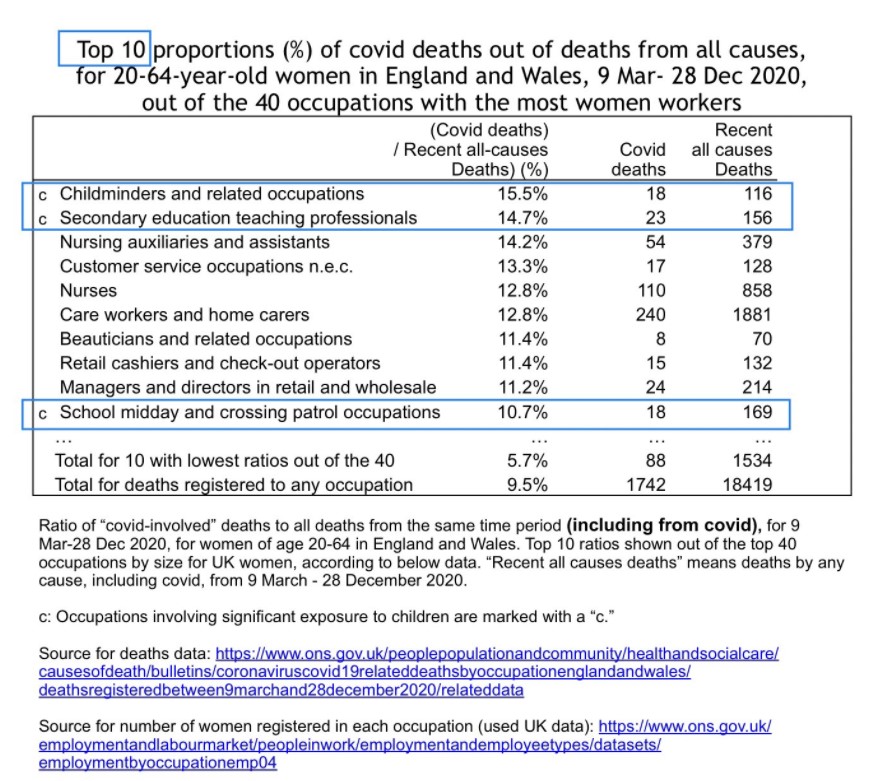

When that comparison is made using data for women , the grim ranking puts childminders first - but secondary school teachers second. This is also her finding when she ranks data using a measure called "Age Standardised Death Rates".


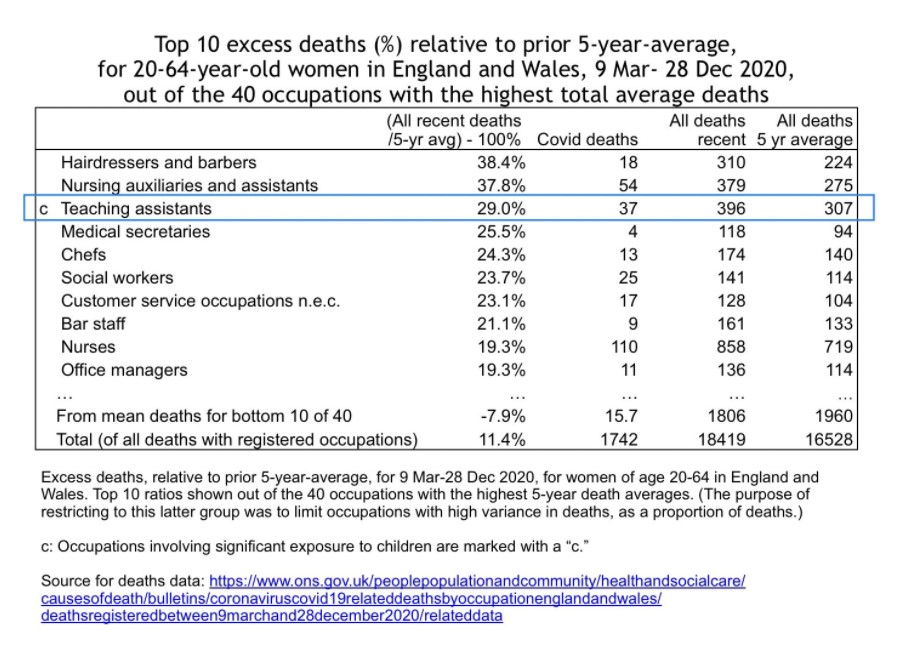
Other comparisons give slightly different rankings. For example, Sarah's analysis based on 'excess deaths' relative to previous years sees teaching assistants ranked highly. 

She also points out that, owing to a delayed rise in primary student infection, primary death counts may not have been so impacted until after the period that the ONS data covers. But school staff absence data shows that, in November and December, primary school teachers had nearly the same rates as secondary colleagues. Sadly, the resulting death rates are therefore also likely to be similar too.

Either way, these are very different conclusions to those drawn by the ONS.

No justification for fully opening schools

Sarah Rasmussen's analysis confirms that the ONS occupation comparisons data gives no justification for arguing that it is safe to now push ahead with fully opening schools. 

For a start, the data is based on a period when schools were largely only partially open. Her analysis also shows that the conclusions drawn by the ONS on the risks to school staff are highly debatable.

But, of course, the NEU's insistence on school and college safety isn't just about our members, it's about the communities that we serve. Yes, fully opening schools while infection rates are still so high would result in further staff deaths but it would also result in many more infections and deaths in the wider community too. The growing concerns over 'Long Covid' will be an additional concern for staff and parents alike.

Just to take one last piece of data, politicians should study the data being provided by Public Health England on Covid outbreaks that are still ongoing in school settings. Yes, thanks to the U-turn forced on the Government by the NEU's insistence that our members would not return to unsafe workplaces, the numbers of outbreaks in schools has thankfully declined. But look more carefully. In SEN and Nursery settings - the places where Headteachers are being put under immense pressure to remain open to as many students as possible, the numbers of outbreaks are rising.

If schools are fully opened now, this will be the dangerous outcome across all settings. Once again, schools will act as the "vectors for transmission" that even the Prime Minister acknowledged had occurred with the new variant.

So let's insist politicians draw the right conclusion - keep school numbers at a safe level and keep our schools and communities safe. 

Monday, 18 January 2021

Take Action to ‘Insist on the Checklist’ - and to ‘Make Early Years Safe’

#InsistontheChecklist

The determined stance taken by thousands of NEU members at the start of term in refusing to return to an unsafe workplace helped ensure that most schools are now only open to reduced numbers.

However, too many classrooms remain dangerously full. Too many schools are making unreasonable expectations. That’s why it’s vital that NEU members continue to use their collective strength to protect the safety and welfare of staff and our school communities.

Every school group immediately needs to read the new ‘checklist for partial opening’ that was issued on Friday by the GMB, NEU, Unison and UNITE. It contains vital guidance to union members to make sure that schools are as safe environments as they can be, particularly given the greater transmissibility of the new Covid variant. I have produced an A4 poster summarising the key points.

NEU Districts are reporting on gains that have already been made by keeping up the pressure on Local Authorities, e.g. reversing unsafe Lateral Flow Testing isolation protocols.

Enormous pressures are being put on Heads to take in greater numbers of keyworker and vulnerable pupils than safe distancing and ventilation requirements allow.  We must “insist on the checklist” to protect the health and safety of our colleagues, our students, and our school communities.

“We are strongest when we act collectively”

As the message from the NEU General Secretaries makes clear, the union “will back every workplace group that feels the need to take action”. Their guidance recommends the following steps are put into place as quickly as possible:

* Speak with members at an online meeting and see if they share common concerns.

* Arrange a meeting with your head and/or SLT to raise concerns.

* Report back on the response from leadership and discuss next steps with members, including escalation and further support.

* Escalate concerns with your branch and seek more support.

Two forms of action are mentioned in the guidance:

1) Moving quickly towards a ballot for industrial action.

* Trade union legislation means that the legal ballot process takes a few weeks, and a mandate for action also requires a good turnout in a postal ballot.

* To avoid delays, reps should check their membership lists immediately. Make sure the Union has an accurate list of your current membership and home addresses are correct for a postal ballot.

2) The union will support members' use of ‘section 44’

* Ask the Union for advice so that section 44 letters can be tailored to your school circumstances.

A national ballot as a safeguard against an unsafe return 

As the New Year U-turn showed, we can make gains when we stand together across a workplace, or a group of workplaces, but we are even stronger when we act together as a whole union.

With the NHS still under huge pressure, none of us knows how long this period of ‘partial reopening’ will need to last. But it’s clear that the Government want to try and fully open schools as soon as they can. We must again make clear that full opening must be “Only When It’s Safe” to do so.  I believe that launching a ballot for national action now could help make sure we have the safeguard of an action mandate in place where it might be needed to oppose an unsafe return.

***

Reports I have received from around the country indicate there are some particular threats ongoing at present. These include:

Make Early Years Safe

Nursery classes are being bullied to stay fully open under the threat of financial penalties. In at least two London boroughs today, Heads that had implemented rotas of safer, smaller, numbers of children have been told that they must open fully or lose income for the places they do not believe that they can safely fill at the present time. Schools in other areas have had similar threats.

This is both outrageous and dangerous. As the NEU’s #MakeEarlyYearsSafe model letters, calling for emergency funding to be immediately provided to cover additional Covid costs, explained to MPs:

* Anthony Costello, SAGE member and UCL professor of global health and former WHO director, said in The Mirror on 9 January: “We are in a national crisis with a pandemic out of control. We should have no nurseries open.”

* Case rates for nursery-aged children in England are in line with those for primary aged children –216/100,000 in the 0-5 age group, and 236/100,000 in the 5-9 age group.

We need to give confidence to members in Early Years to stand up to these threats. Make sure to identify the members teaching in Nursery Classes in your school lists and build for urgent action.

Supply Teachers

As in the first lockdown, the damage caused by the privatisation of most supply teaching has left many agency staff at severe financial risk. Too many agencies will not even agree to furlough.

Schools should not be looking to save money at the expense of supply teachers, especially not those where a long-term engagement had previously been agreed. The needs are still there to be met. DfE guidance now confirms that agency staff can be used for remote, as well as face-to-face, teaching.

The Supply Teacher Network has produced a Supply Educators' Survival Kit to support colleagues.

Support Staff

Support staff are under some of the greatest pressures at present. Firstly, some schools are operating rotas that insist support staff are in schools all the time while teachers are more likely to be allowed to work from home. We must insist on equality of treatment.

The new joint union checklist includes some important points in defence of support staff colleagues. One of these is the statement that “systems should be in place to ensure a fair balance across the whole staff in respect of working from home and working on site”.

Reports are also coming in of schools using the lockdown as an opportunity to launch restructuring proposals where support staff jobs appear to be particularly at threat. Collective action will be needed to oppose cuts and to defend education and jobs.

Workload and Monitoring

Sadly, while many schools recognise the difficult and stressful circumstances in which educators and pupils are working, some poor managers still seem to be unable to prevent themselves putting staff under unacceptable pressures through unreasonable workload demands and/or by insisting on inappropriate monitoring of online learning. Once again, a collective response is the best way to back up our entirely reasonable demands that good managers support, not bully, their colleagues.