Showing posts with label Pay. Show all posts

Friday, 14 June 2024

My pledges as a workers' MP for Chorley - NHS Pay

Chorley voters have been writing to me to ask that I pledge support for issues that are of particular concern to them. So that they are on the record for all voters, I am posting my response on some of the key issues here, on my blog:

NHS PAY


As a long-standing teacher trade unionist, I fully support the strike action being taken by NHS workers to secure a decent pay rise and am standing on a platform that includes the call for inflation-proof pay rises, and opposition to NHS cuts and privatisation.

As a NEU officer and member, I have helped organise strike action over pay, workload and privatisation. I have helped organise joint protests and attended NHS picket lines, from the first Junior Doctors' strikes (when I was then NEU London Regional Secretary) right up until the latest strikes.

As a KONHP member, I have also helped organise protest stalls highlighting the threats to our crumbling NHS, not least the plans by both parties to use the inevitable problems that come with underfunding and understaffing as an excuse to further widen NHS privatisation.

As a workers' MP for Chorley I would use my position as a platform to speak up for workers in action.

My campaign will be highlighting the issues of NHS cuts and privatisation, including the threats to bed numbers and services from the New Hospitals Programme across Lancashire.

As a final note, my father worked with Nye Bevan in Tredegar on health and housing, so the demand to go 'Back to Bevan' and for the fully funded free and public NHS, decent housing and social care for all - that they fought for - is a very personal one for me too.

So, yes, I fully endorse your demands and hope that, unlike a 'Speaker' who is restricted in their role by 'impartiality', I can be a champion for the NHS and both its users and workers in Chorley and beyond.

[ See also my pledge on Defending Our NHS here: https://www.mpdnut.com/2024/06/my-pledge-as-workers-mp-for-chorley.html ]

Martin Powell-Davies
Trade Unionist and Socialist Coalition Candidate for Chorley

Tuesday, 18 July 2023

Vote Reject!

Last Thursday, the NEU National Executive agreed, by 44 votes to 22, to recommend acceptance of  the government’s latest pay offer - a 6.5% increase for September 2023. Now it’s up to NEU members to decide. An online e-vote opens today, Tuesday 18 July, and runs on to Friday 28 July. 

I am pasting below a statement issued by the five Socialist Party members on the NEC, part of the third of the Executive that voted against recommending the deal, urging NEU members to vote to REJECT it too. They are also hosting a Zoom meeting, tomorrow, Wednesday 19 July, to explain further with an open invitation to NEU members and reps to come and ask their questions and discuss how to build a fighting NEU: 

Accepting the deal means accepting two more years of pay cuts

NEU members have taken determined strike action for good reason. Teachers’ pay in England has fallen by over 20% in real terms since 2010. Food, fuel, rents and mortgages keep going up. But this deal means:

Nothing more offered for 2022

We started the dispute because last September’s award was just 5%, still correctly described on the NEU website as “another huge real terms pay cut”.

You rightly voted by 98% in March to reject a previous deal, although that at least included an extra £1,000 lump-sum for this year. This new deal doesn’t even offer that. If we accept it, we’ll have won nothing more for 2022 at all.

6.5% for 2023 is yet another pay cut 

The general secretaries are claiming the deal should be accepted as it is the “largest ever recommendation” from the School Teachers’ Review Body. But we’re also facing the “largest ever” inflation rates since the STRB began! It’s a lot less than teachers in Scotland have won, leaving their main scale £7,000 better than ours. 

The junior doctors have already rejected their offer of 6% saying it “represents yet another pay cut in real terms”. We should do the same. RPI inflation is still running at 11.3% annually, and at 24% compounded over the last two years. Accepting this deal means accepting two more years of pay cuts. We must fight on too.

The deal is NOT fully-funded - we can, and must, win more

The deal is being sold to members as being ‘fully-funded’ but we are yet to see figures which show clearly that this is the case. Yes, our pressure has forced the Tories to divert some more money into teachers’ pay, but only enough to fund “the first 3% of the pay award”.  Schools are being expected to fund the rest out of existing budgets. However, some won’t be able to without making further cuts. The Tories know that - which is why they’ve also announced a £40m ‘hardship fund’ for “schools facing specific financial difficulties as a result of this offer”. But that’s just a few hundred pounds each when divided up over thousands of schools.

Instead of making more cuts and attacking the most vulnerable - like Sunak’s announcement that he will be increasing the racist charges on migrants - the enormous wealth stashed away by the super-rich should be used to fund education, the NHS and all the other services needed by the children and families we support.

The Tories say this is their “final offer” - but they said that before in March. They’ve been forced to shift again because our action has put them under massive pressure, especially with a General Election on the horizon. So now is the time to increase that pressure, not to agree an inadequate deal – we can win more!

Members should vote to REJECT the deal and join us in arguing at the National Executive and throughout the union for a bold, serious, escalating fight in the autumn! Ask us how at our ‘Zoom’ on Wednesday 19th July.

NEU NEC members Sean McCauley, Sheila Caffrey, Louise Cuffaro, Nicky Downes, Steve Scott

Monday, 26 September 2022

FAQs - why NEU members should vote for action

With the preliminary ballots for NEU Support Staff members, and in Sixth Form Colleges already open, the NEU's electronic vote for teachers in state schools opened this weekend. Already tens of thousands have voted. Now we all need to drive that vote up until we smash through the 50% threshold that will be needed in the further, fully postal ballot required to call a strike under the Tories' anti-union legislation. 

Many members understand straight away why they need to vote for action but some may have a few queries before they do. Here's answers to four of the questions that I have come across in speaking to members in my District:

WILL STRIKING MAKE ME LOOK BAD WITH MY HEAD AND PARENTS?

No. There's no reason to feel awkward about taking strike action. It's your legal right to do so, as long as we win the ballot with a high enough turnout. Our action would be a national strike to campaign to win a fully-funded pay rise. It's not directed against your Head or your school, in fact it would help your school by making sure they had improved funding and fewer problems with retaining and recruiting staff.

Of course, parents will be inconvenienced by a strike but, as railworkers and postal workers have found when they have taken strike action over the summer, with everyone's cost of living rising, there's a widespread understanding that trade unions have no choice but to take action. We will also produce information for parents and governors so that they can read the facts about our campaign.

CAN WE AFFORD TO STRIKE?

With the cost of energy, transport, food and housing rising steeply, and inflation forecast to rise even further by 2023, can we afford not to? If we don't take action - especially when other unions are - that will only encourage this government to think they can keep cutting school budgets, holding down our pay, and piling on yet more scrutiny and workload.

Strike action has already won victories for trade unions in a number of local disputes. Even the threat of action has just won an improved pay offer for Scottish council workers - including school support staff - and over £400 million in extra funding to pay for it too.

HOW CAN SCHOOLS AFFORD TO PAY MORE?

The government's 'mini-budget' has shown it has money to spend - but it will need action to persuade them to direct some of it into education, instead of towards tax cuts for the wealthy. 

It's not a question of ‘either’ pay ‘or’ school funding - our campaign is to win both. So, don’t be put off voting for a pay rise because you fear school budgets won't be able to cope. The battles for better pay and for better school funding are two sides of the same coin. Strike action is the most powerful way of winning both.  

CAN STRIKE ACTION WIN?

Yes. With support staff unions consulting over pay, and the NASUWT teaching union also talking about action, NEU members can vote for action with confidence that our action could be taken across school staff, and alongside other unions in the public and private sectors too. 

We won't be alone. With inflation rising, the government is under growing pressure to act. Our action can make it think again on pay.

So, keep talking to your colleagues and make sure everyone has voted - and voted YES to action. EiS members in Scotland have just secured a 78% turnout, with 91% voting in favour of strike action - can we do the same?

You can download a Socialist Party in Education bulletin containing some of the key information about the ballots here.


Friday, 18 February 2022

We need a timescale for a ballot for action to win on pay

For the last few weeks, NEU Branch Officers and school reps have been working hard to encourage teacher members to respond to an online survey about pay. In the end around 70,000 members, a little under 30% of those who had been polled, responded to the texts and emails sent to them nationally.

This was a very good initial turnout, particularly given that a turn towards campaigning on pay had only recently been made by the Union. A 0% ‘pay freeze’ had been imposed on teachers paid under the School Teachers Pay and Conditions Document for the previous 2021 pay award without the Union responding in the way that is now being done. Despite the short lead-in to the survey, 74% of those voting were already saying they would support strike action over pay.

Two NEU branches, East Riding and Redbridge, even managed to exceed the 50% turnout that would eventually be needed in a formal strike ballot under the anti-trade union legislation, showing how other branches could also improve their turnout with the right approach, support and organisation.

The Executive agrees we will need to ballot – but when?

On Thursday, 10th February, a special meeting of the NEU Executive met to discuss the overall response and to plan the next steps in the pay campaign. Important steps were agreed but, in my view, a key step was missing, and that was to agree a clear timescale for proceeding to a ballot for strike action.

A timescale for a ballot is not just a small detail, it is a key part to any pay campaign. Of course, NEU reps and officers can, and will, encourage members to take part in the demonstrations, rallies and other activities that were agreed by everyone on the Executive. However, in all those activities, it will be important to explain to members that we will need to vote for, and firmly enact, strike action if we are really to influence this Government and warn off its big business backers calling for Ministers to maintain ‘wage restraint’.

A timescale provides a sense of urgency and an assurance to members that it’s important for them to attend the demos and rallies, because they are part of a serious campaign to win our pay demands - of an 8% pay rise over both of the next two years across all points on the pay scales. It also gives a clear idea to busy branch officers, reps and staff as to what priority needs to be given to updating addresses, holding meetings and other preparations.

When I heard that the Executive had not agreed any timescale, and posted criticism on my personal Facebook page last week, I received angry responses from members of the majority ‘NEU Left’ group on the Executive including accusations that I was ‘misrepresenting’ what was agreed.

This has since been followed by an article on the NEU left blog that criticises “some in the union who don’t support [the agreed] strategy, calling instead for an immediate indicative ballot. Some of those people have said that the Executive have ruled out strike action. Nothing could be further from the truth. We question the motivation behind this spreading of misinformation”.

Now that’s quite a serious accusation and, although nobody is specifically named, presumably aimed in part at me. So let me explain further as to why, no, I am not spreading misinformation [on the contrary, as I explain below, no Executive amendment actually called for an “immediate indicative ballot”] but, yes, I am raising questions and concerns. I do so not light-mindedly, but because, at a time when prices are rising so rapidly, alongside pay cuts through national insurance increases, a failure to win on pay would be so serious for so many members.

What was agreed by the Executive – and was voted down

What was agreed by the Executive was a commitment “to put every effort nationally, regionally and locally to put ourselves in a position to call and win a national ballot at the earliest possible opportunity”.

But the Executive still needs to clarify what timescale they are looking at and how that relates to the timetable for the Government and the Review Body to make decisions over teachers’ pay.

As has now become their standard practice, the Government are likely to announce the next pay award in late July. But, this time, they are going to impose a two-year pay award for 2022/3 and 2023/4. Therefore, our strategy needs to have maximum impact before July.

Recognising this, a ballot timetable crafted to allow strike action to take place in July was put to the February Executive. It proposed that the next half-term, up until Easter, should be used to share best practice amongst reps and branches and identifying areas in need of further support. 

Meetings, rallies and demonstrations, such as the one now called by the TUC on 19 March, could be used to increase confidence and engagement, building on members' concrete experience of rising bills and falling incomes.

All these steps would be preparation for launching an indicative ballot from April’s Annual Conference. The indicative ballot would then have been followed by an emergency National Executive meeting on 14 May, hopefully agreeing it was in a position to move to the formal ballot needed to sanction strike action before the end of term.

However, this proposal was only supported by a minority of Executive members. This decision effectively rules out any chance of building for national strike action by July. This, I believe, is a missed opportunity and presents a complication. The Union will now have to take action to persuade the Government to reverse its decision, rather than before it is made.

A clear announcement needed by the Union

I appreciate that the NEU Left majority on the Executive believe the Union would not be ready to win the necessary turnout and majority by July. But when do they think “the earliest possible opportunity” will be? What timescale is the Union working towards?

The NEU left blog concludes that the agreed strategy “will include moving to an indicative ballot – whether in the autumn term or sooner if we judge the mood is strong enough and we can win it”. Leading NEU Left member Alex Kenny has written to officers in London stating that “the fact that we may be looking at a two year pay award gives us a longer timeframe over which we can map this campaign”. But will a full ballot be launched early enough to give members confidence that an inadequate two-year pay deal can be reversed, and not become seen as a fait accompli?

Postponing a national ballot doesn’t guarantee generating greater momentum, delay can also see it being lost. By constantly telling activists that a majority can’t be won, and postponing action to some undefined future date, there is a danger that some in the Union conclude that national action can never be taken. Our strategy then becomes only one of building workplace-by-workplace, following the Union’s long-term ‘VEVE orientation’, but never brings members together in united action.

This would be a one-sided strategy that risks demoralising activists and failing members. Of course, we need to build workplace strength and rep density and organisation but the key drivers of pay, workload and funding cannot be tackled at a workplace level alone, they require national action. A serious campaign for a national ballot can help build at workplace level and vice versa.

After responding in such high numbers to the initial survey, NEU members now need a clear message about how the Union intends to, not just protest, but win on pay, reversing any two-year pay cuts imposed on teachers in July. It also needs to make clear to support staff members how we are planning to organise around their pay award as well.

Now that a timetable seeking to take national action before the pay award is announced has been rejected, is it not now time to make clear to members, and the Government, that the NEU will however ballot for action in the autumn term if our pay demands are not met? Such an announcement would give the whole union a timescale to build around.

Sunday, 2 January 2022

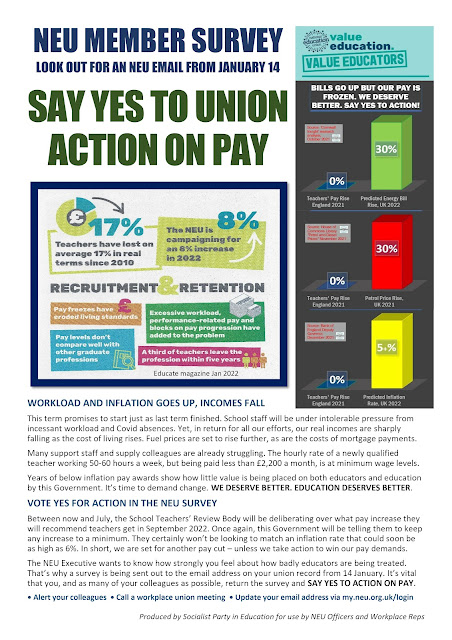
NEU Member Survey - say yes to action on pay

WORKLOAD AND INFLATION GOES UP, INCOMES FALL

This term promises to start just as last term finished. School staff will be under intolerable pressure from incessant workload and Covid absences. Yet, in return for all our efforts, our real incomes are sharply falling as the cost of living rises. Fuel prices are set to rise further, as are the costs of mortgage payments.

Many support staff and supply colleagues are already struggling. The hourly rate of a newly qualified teacher working 50-60 hours a week, but being paid less than £2,200 a month, is at minimum wage levels.

Years of below inflation pay awards show how little value is being placed on both educators and education by this Government. It’s time to demand change. WE DESERVE BETTER. EDUCATION DESERVES BETTER. 

VOTE YES FOR ACTION IN THE NEU SURVEY

Between now and July, the School Teachers’ Review Body will be deliberating over what pay increase they will recommend teachers get in September 2022. Once again, this Government will be telling them to keep any increase to a minimum. They certainly won’t be looking to match an inflation rate that could soon be as high as 6%. In short, we are set for another pay cut – unless we take action to win our pay demands.

The NEU Executive wants to know how strongly you feel about how badly educators are being treated. That’s why a survey is being sent out to the email address on your union record from 14 January. It’s vital that you, and as many of your colleagues as possible, return the survey and SAY YES TO ACTION ON PAY.

Download the flyer drafted by Socialist Party in Education for use by NEU Officers and Reps as a pdf, jpg or an editable word document from this folder

Saturday, 4 December 2021

Organise to win the NEU's 8% pay demand

At long last, concrete steps are being taken by the National Education Union to build towards the national strike action that will be necessary to win a pay rise that reverses the continuing decline in teachers’ real salaries. But the delay in launching a clear campaign means that urgent steps now need to be taken at every level of the Union if we are going to ballot successfully for union-wide industrial action.

Download a PowerPoint (this version by NEU NEC member Sheila Caffrey)

Organise now so that we can win a national strike ballot

Ever since July, when the Government confirmed they would be imposing a 0% pay freeze on teachers’ pay in England for 2020/21 in England in July, the five Socialist Party members on the NEU’s National Executive, alongside others, have been pushing for the Union to launch a clear campaign to prepare for a national ballot. (See: https://www.socialistparty.org.uk/issue/1150/33107/06-10-2021/neu-national-executive-agrees-campaign-on-pay).

It was a demand also taken up in my campaign for election as NEU Deputy General Secretary. In my election address, I spelt out that “we should already have responded with a plan of action” and warned that “hesitation only invites further attacks”.

Faced with rising prices, pressure has also been building from below. When teachers see their pay frozen, at the same time as even official inflation rates are rising to 5%, they expect their Union to be giving a lead! Of course, the cost of many essentials is rising even faster – like petrol and gas bills. Next April’s hike in National Insurance contributions will further eat into incomes.

Kevin Courtney sets out the NEU's 8% pay demand

NEU members will therefore be pleased to see Kevin Courtney, Joint NEU GS, taking to social media to call for a fully-funded 8% pay rise for teachers, both in 2022 and 2023. Not only would such a pay award start to reverse the years of real-terms decline in teacher incomes, it would also make sure that the School Teachers’ Review Body (STRB) had met its own recommendation of an initial starting salary of £30,000 for newly qualified teachers.

This follows the meeting of the NEU National Executive last month where, for the first time, there was a serious discussion about how to urgently mobilise across the whole Union. Executive members are now being urged to brief branches about the campaign, and to build for reps’ briefings in the New Year. By then, the Government will also have issued its remit to the STRB for the 2022 pay award, so members will know concretely the size of the threat we face for next year’s pay too.

While these moves are welcome, a real sense of urgency is now required to make up for lost time. As things stand, the latest campaign email issued to members still fails to mention a national pay campaign at all! That has to urgently change. Winning on pay must become a priority focus for all, staff, local officers and activists alike.

No section of the Union can be allowed to drag their feet over the issue. Nor must the members’ survey planned for mid-January be used as an excuse to back away from action. It’s inevitable that, with such a short run-in to the survey, turnout will not yet be at the levels needed to beat the legal thresholds in a formal strike ballot. Instead, Socialist Party members on the NEU NEC are urging that the survey is seen as part of an escalating campaign and used as an opportunity to identify both areas of strength and those where we need to build more engagement.

A timetable for action

A good turnout in a January survey could then be built further in a full indicative ballot later next term. NEU Annual Conference over Easter could then be used to launch a formal strike ballot with maximum press publicity.  Such a timetable would allow mass NEU strike action to take place to put maximum pressure on Government before the STRB issue their pay recommendations in July.

Such a bold campaign could not only help to win the NEU’s pay demands but also start to reverse the “race-to-the bottom” for all workers. That will also need to include winning for support and supply staff members of the NEU who have seen their already low incomes falling further.

It can also start to rebuild the confidence and organisation of NEU members as a whole, spurring on our fight on all the other issues we face, like workload, testing, safety and academisation.

Tuesday, 17 August 2021

Oppose the Pay Freeze - but with action, not just words

After all that educators have done throughout the pandemic, the ‘reward’ that we have received from this Government has been a pay freeze for teachers and a miserly 1.75% for support staff. When inflation is heading towards 4%, these are real-terms pay cuts.

If we fail to respond to this insult with action, we will only be inviting more attacks - like a lengthening of the school day and yet further cuts being made to school and college funding.

Letters and petitions are not enough. We need to learn the lessons of how we forced a U-turn over Covid safety - by using the collective strength of the whole union acting together.

That's why I say:

Download and share as a leaflet
BRING UNIONS TOGETHER in a joint campaign to defend pay and public services

ORGANISE at every level of the Union so we are ready to win A NATIONAL BALLOT 

SUBMIT A CLAIM FOR A NEW NATIONAL CONTRACT for all staff - with binding pay scales, no performance pay, legal limits on overall working hours and class sizes

FULLY FUND SCHOOLS to meet needs

Accepting these pay cuts will only invite further attacks

The Government left it to the very end of last term to confirm that their ‘thank-you’ for all of the exhausting work we carried out throughout the pandemic would be to impose a 0% pay freeze on teacher salaries. 

Support staff had already been offered just 1.75% and teachers in Wales 1.75% too. Even NHS staff have only been awarded 3%. With the Bank of England predicting inflation at 4% by the end of the year, these are all actually pay cuts. 

But this pay injustice should come as no surprise. The pay freeze was first announced last November. Ministers waited to see what response they would get from the NEU and other unions. They obviously concluded that they could get away with it. We need to prove them wrong!

We are facing a callous, conniving Government that, having looked after their friends during the pandemic, now wants school and college staff, and the communities we support, to foot the bill through cuts to our pay and conditions - and to the learning conditions for our students.

If they succeed with imposing pay cuts, Ministers will only gain in confidence to deal us another blow. They are already threatening to extend the school day, worsening our contracts and workload yet further.

Letters and petitions alone will have no real effect. Instead, we need to learn the lessons from last January when, faced with NEU members invoking their Section 44 Health and Safety rights union-wide, Boris Johnson was forced into a U-turn over his unsafe school opening plans.

That’s why I believe we now need to act with confidence and determination and prepare for national action.

Organise to win a national ballot

The NEU rightly stresses the importance of building workplace strength. Important victories have been won by individual school and college groups taking strike action over the last year. But when we face a national attack, as we do over pay, then winning at a workplace level is not enough. We need to organise together nationally.

Of course, the Government has deliberately put a significant hurdle in the way of unions by imposing a 50% postal ballot turnout threshold for industrial action to proceed. But, if the NEU is going to be able to defend educators and education, it has to overcome that barrier. The job of a union leadership is to work out a plan to make sure we can do so. I am standing as NEU Deputy General Secretary to provide such a lead.

Martin’s strategy to win

Immediately, we need to make clear to both Ministers and educators that we aren’t accepting this attack lying down. Meetings and rallies need to be organised to explain and to convince NEU members of the need to act. They should be backed up with campaign materials for colleagues - and for parents and the public too.

Locally and nationally, we need to bring colleagues together from other unions, including in the NHS, to build a co-ordinated campaign of action, starting with  setting a date for a national demo.

We need to organise meticulously at every level of the Union to put in place the steps needed to ensure we are ready to proceed with a successful ballot, learning from NEU groups and other unions who have successfully met the thresholds.

If we are going to build for national action, we should also widen our demands beyond just the pay award. We should submit a claim for a new National Contract for all staff that includes binding pay scales on all employers and an end to performance pay. But our working conditions are just as important - perhaps more so for many staff given levels of workload. Our claim should also include a call for legal limits on both class sizes and on overall working hours, not just on teachers’ ‘1265’ directed hours. 

Finally, for schools to be able to both pay us properly and employ sufficient staff to meet pupil needs, our action needs to be part of a campaign to reverse cuts and win the funding that our schools and colleges need.

#Martin4DGS - ZOOM MEETING

Turn words into action - Build for a national ballot

Sunday September 26th - 16.00

Meeting ID: 890 2272 9469


Sunday, 25 July 2021

Prepare for action to oppose the pay freeze!

Here is the video statement that I released on my Martin4DGS campaign Facebook page, immediately after the STRB confirmed a pay freeze was to be imposed on teachers for 2021/22 (with a paltry 1.5% award already separately imposed on support staff). You can watch it here on YouTube.


The school teachers' review body (STRB) report was finally released, predictably late at the end of term, and predictably inflicting a pay freeze on the vast majority of school teachers.

And we knew that was coming. Because the government has made absolutely clear that it wants us to pay for the crisis that it has created. This is despite all the work we have done throughout the pandemic, alongside our colleagues in the rest of the public and private sector.

And so the NEU's press release is absolutely correct to say that it is unacceptable to be imposing a pay freeze. When inflation is rising, it is, in reality, a pay cut. But it's going to need more than a press release to stop these kinds of attacks.

We need to learn the lessons of how we forced the prime minister into a U-turn over Covid-related health and safety, and that's by using our collective strength and using it nationally.

That's why in November, when the pay freeze was first mooted, I called for unions to call a joint conference to put together a plan of action, of meetings, rallies, demonstrations and industrial action, to oppose the attacks that were coming on pay.

In the hustings for the NEU deputy general secretary election similarly I've consistently explained that we need to organise that kind of a plan. To go out to inspire and explain to our members the action that's going to need to be taken. To make sure that we put in place the steps that can help us to meet the ballot thresholds, with addresses being checked, so that we can return those ballot papers with the maximum turnout that we can.

And I've also said that we need to produce materials for parents and the public to explain why, when the review body says that already a fifth of teachers are leaving the job within the first two years, a third within the first five years, a pay freeze like this will make things even worse and create even more instability in the classroom.

But some of my opponents say: the problem is that Martin underestimates the difficulties ahead of us. He thinks we can win a national ballot very easily. Well actually no, the opposite is the case. I know the hard work that is required to win a national ballot and that's why I'm so frustrated that the preparations haven't been done.

And we cannot delay now. The preparations have to be made so that we can defeat the pay cuts and win the demands that we also have to get rid of performance-related pay; and also to win on workload, a limit on overall hours - all things that are covered by the remit of the STRB and the School Teachers' Pay and Conditions Document.

And last but not least, we also need urgently to bring the unions together to work out a joint plan of action so that we can work together to defend our conditions and our pay and also defend the services that we work in. Let's get on with it, let's not delay.

Martin Powell-Davies, candidate for National Education Union Deputy General Secretary - 21 July 2021

Friday, 9 April 2021

Why we need a National Contract for Education

NEU Conference 2021 has had to take place via Zoom, with delegates sitting at their own homes. Such a Conference has obviously not been without its glitches and idiosyncrasies but, in the end, managed to debate and agree a wide range of policy.

Disappointingly, one of the few motions that was never reached was a motion that I had hoped to propose on a “National Contract for Education”. Conference voted to close the debate before it was heard, even though there would have been time to debate it, and still leave time for another important unfinished motion on Pride in Our Union.

However, while the debate was not had at Annual Conference, it’s certainly a proposal that I want to continue to raise for discussion during the campaign for Deputy General Secretary. 

As usual, our Annual Conference has agreed many good demands but the question for delegates as we draw Conference to a close is always the same – now, how do we achieve them? How can we defend pay, jobs and conditions? How can we get rid of SATs, Ofsted and League Tables for good - and build a curriculum based on equality and the real needs of children and our communities? 

The last year of the pandemic has shown that lobbying alone will not succeed, especially now that the Labour Party front bench can no longer be relied on to support NEU policy as under Jeremy Corbyn’s leadership. The successful use of Section 44 showed in January how we can win - by giving a clear national lead, calling on members to act together union-wide.

The Motion on the National Contract would have come at the end of a series of motions around pay, workload and conditions – but it was the motion that could have brought those together in one national strategy.

Because, while we can – and will – continue to win some gains at a school level, issues that affect every educator will need to be tackled by acting across employers – and across the whole Union. How do we do that?

We all know the organising watchwords we use when we train our reps – that our demands need to be “deeply felt and widely felt” if we are going to be able to act collectively. Now for some educators, their key grievance will be workload, for others pay, for others job losses and the lack of support for students. A campaign for a new ‘National Contract’ for all can bring together those key grievances into one unified campaign – and form the basis for such a unified national campaign of action. 

The motion suggests a series of demands:

Firstly, to “Pay school staff properly” – linking the demands we agreed elsewhere in Conference, for significant pay awards for both teaching and support staff and for guaranteed pay progression, not PRP. The Contract must also include trade-union negotiated common pay scales – together with additional London and Fringe allowances – to replace the increasingly fractured pay scales across different employers.

Secondly “An end to excessive teacher workload” – to stop the burden of 50 hour working weeks and unpaid overtime driving staff out of the job through overwork. The Contract should add the long-standing demand for a minimum 20% PPA – plus additional time for those with additional responsibilities – so staff have time to prepare in the school day, not in their evenings, weekends and holidays. The contract must set a real limit to working hours. That doesn’t just mean limiting teachers’ “directed time” but an end to the open-ended wording in the STPCD that also asks for the “additional hours as may be necessary to enable the effective discharge of the teacher’s professional duties”.  

Thirdly “Sufficient Staff to meet needs” - a limit on hours will only be feasible if it is combined with expectations of work that can be achieved within that limit – for teachers and support staff. That means a Contract that also sets out a requirement for trade union negotiated policies, not least on assessment and planning. It also means making sure employers have class size limits and staffing structures that provide the support needed for students, rather than just having to fit to an inadequate school budget.

Fourthly, “Collective Bargaining and Accountability”- having used our workplace strength together to win national demands, then, in turn, we need to use that national strength to insist that every workplace, and every employer, has its own negotiating structures to resolve how our national contractual rights are applied locally, and to negotiate the individual issues that can arise in a particular sector or school.

Where we have national recognition, we should use the opportunity given to us already via the Review Body process to call for these demands as part of an overhaul of the STPCD – while also seeking direct negotiations and collective bargaining for all our members.

Of course, those overtures will be rejected by this hard-nosed Government – unless they are backed up by the threat of national action that would be required to win a national contract. 

As the Motion proposed, however, ballots could also be counted by employer so that, alongside national negotiations, the Union can also pursue disaggregated action to make gains on an employer-by-employer basis.

Clearly, union-wide action needs careful preparation. That includes the ‘technical’ preparations of making sure we are ‘ballot ready’ to meet the legally imposed thresholds, with correct home addresses and setting up mechanisms for reps to check we are getting the vote back postally in as high a turnout as possible.

It needs the campaign preparation - taking the campaign out to every member, using what we have learned from using online methods like Zoom, as well as the physical meetings and rallies.

It also need taking out more widely to parents – to explain why a National Contract for staff is also a National Contract for Education – to stop the constant staff turnover, to limit class sizes and insist on sufficient staffing to improve the learning conditions for young people

But above all, pursuing this approach means we move from lowering members’ confidence by emphasising the barriers in our way – and instead start to raise members’ confidence by emphasising what needs to be done  – and then works out soberly but with determination, how we’re going to do it.


The full wording of Motion 14 - including amendment 14.1 which, as proposer, I was accepting - can be found here.


Friday, 20 November 2020

Pay freeze threat must be answered through co-ordinated action

So as a big 'thank you' for all we've done in the pandemic, Rishi Sunak has decided on our reward - a three year pay freeze.

This Government was only ever interested in keeping schools open for their own economic interests, not the children's. Not content with putting our personal safety at risk and expecting us to work even longer hours than usual, they now want us to foot the bill for their failures too.

The Government can’t pretend that “we’re all in this together” anymore. Contrast the way their corporate friends have been rewarded through billion-pound Covid contracts. 

Nor should we accept that, just because private-sector employers are putting the boot into their employees, public-sector workers should share in the misery too. No, instead of a race to the bottom, public sector trade unions should give all workers a lead and demand a fully-funded pay increase for all. We must demand an end to the cuts that are undermining public services and also threatening more job losses too.

But the key question for the NEU and other public sector unions is, how do we answer this attack? 

It can't be fought by just more petitions, or by school by school action. A national strategy is needed, and yes, that means building for collective action. If a clear lead is given, members will respond – but leadership is key.

The National Shop Stewards Network has just put out a call for an immediate Day of Action on 5th December, the first Saturday after ‘lockdown’ is due to end. Local trade union led socially distanced protests should be organised in every town to give an immediate answer to Sunak and the Tories.

The NEU should immediately be getting in touch with the leaders of all the public sector unions to plan a joint campaign of action. That could include nationwide protests and demonstrations in the New Year, building towards the ballots for coordinated strike action that will be needed to defeat this pay robbery. 

Time to take action again - as the NEU!


Friday, 23 August 2019

School Teachers’ Pay – 2019 Review Body Report confirms crisis – but completely fails to address it


At the end of July 2019, the Government again belatedly released the latest recommendations of the School Teachers’ Review Body (STRB) for the 2019/20 national pay award for teachers in England.

STRB share responsibility for the disastrous effects of pay restraint and performance pay

This was the STRB’s 29th Report since it was set up under the Conservative Government in 1991, as part of the neo-liberal ‘education reform’ measures designed to undermine teacher trade unionism and to cut and privatise education. In the succeeding three decades, where teacher trade unions in England have been left without direct negotiating rights over national pay and conditions, the Tories’ original objectives have largely been achieved. Pay levels have fallen overall while teacher workload has risen, a clear national pay structure has been shattered by performance pay and ‘freedom’ for schools to set their own pay scales, and school budgets have been cut with UK education spending as a proportion of GDP falling back to levels last seen in the 1960s.

In all those years the STRB has, of course, proved to be far from the ‘independent’ body that it claims to be. In reality, the Review Body’s various dignitaries have, with very few exceptions, faithfully carried out their role of making recommendations in line with Government policy – i.e. pay restraint and, as was their remit from the outset, to “consider how the pay of schoolteachers might be more closely related to their performance”. https://api.parliament.uk/historic-hansard/lords/1991/dec/17/teachers-pay-and-conditions-act-1987.

The members of the STRB have to share responsibility for the disastrous effects these policies have had on teacher retention and morale. Ironically, with the greater ‘freedoms’ that academy chains were given to ignore the findings of the STRB altogether, some chains, like E-Act, are now discussing using them to get rid of performance pay in their schools because of the damaging effect it has had on teamwork and creativity. https://www.tes.com/news/meet-academy-boss-who-wants-scrap-performance-related-pay.

2019 Report fails to seriously challenge the spending limits placed on them by Government

The latest remit given by the Secretary of State to the STRB in 2018 contained an obvious contradiction. It asked them for recommendations that would “promote recruitment and retention, within the bounds of affordability across the school system as a whole”. But, of course, unless the imposed spending limits are seriously challenged, teacher pay and conditions, and the resulting teacher retention crisis, cannot be seriously addressed.

The Government remit stated that only a 2% increase in per teacher pay was affordable nationally. Faced with the damning evidence that it had collected about the threat of teacher shortages (see below), the STRB recommendations pushed that figure up slightly to a 2.75% increase for 2019/20 and this has been accepted by Government. For the full 2019 STRB Report, see: https://www.gov.uk/government/publications/school-teachers-review-body-29th-report-2019.

A 2.75% pay award is still only equivalent to current RPI inflation. It does nothing to address the 15% fall in the real terms value of teachers’ pay since 2010 estimated by the NEU. The STRB doesn’t challenge this claim, itself accepting that “A decade of relative decline has taken the teachers’ national pay framework too low in relation to the graduate labour market and the wider economy”.

Instead of demanding the additional funding needed to significantly increase salaries, the STRB Report makes clear that their 2.75% recommendation was based without any “assumptions about additional funding being provided to schools by the Government from September 2019”. While the Report accepts that “for some schools, the implementation of a pay uplift in September 2019 will be a significant challenge” their main emphasis is on the ‘autonomy’ that schools have both over their finances and over individual performance pay decisions, and the fact that most schools still carry surpluses from past savings. In other words, when push comes to shove, it’s up to schools to balance their budgets not for the Government to fund schools adequately.

While most schools might still be formally in surplus, the reality, as acknowledged in the STRB Report when reporting on Education Policy Institute’s 2019 research, https://epi.org.uk/publications-and-research/school-revenue-balances/, is that 48 per cent of maintained primary schools and 60 per cent of maintained secondary schools spent more than their income in 2017-18. 30% of maintained secondary schools are already in actual deficit with an average deficit of a staggering £484,000! (Fig 32).

The danger is clearly therefore that some cash-strapped schools will indeed try to hold back their pay bill in other ways, particularly through denying pay progression. Alternatively, more jobs and resources could be cut to pay for increased pay costs.

Schools should refuse to make such invidious choices and budget for what is needed to fund pay progression and annual increases for all staff, as well as the staffing and non-staffing resources needed to meet needs. In turn, Local Authorities should support schools going into deficit as a result and call Boris Johnson’s bluff. In standing to become the new Tory leader, Johnson promised more school spending. So, rather than make cuts, schools should demand the Tories – or whatever Government might emerge over the next weeks and months – provides the funding needed.

Interestingly, the STRB itself cautions that prioritising short-term savings “instead of teacher supply through an investment in pay” will only lead to “additional costs and reduced productivity across the education system in the longer term”.  It does advise the Government to make funding for teachers’ pay a priority in their forthcoming Spending Review. Of course, what is really needed is a Government that is seriously investing in education and for the future, not just considering the usual short-term objectives of capitalist economics.

2019 STRB Report confirms the depth of the recruitment and retention crisis

As with previous STRB Reports, the data hidden within the 2019 Report reveals the real costs of failing to invest in staff salaries and education as a whole and is in contradiction with its final timid pay recommendation that fails to challenge the Government’s spending limits.

The STRB’s summary of its findings on teacher recruitment and retention presents what it itself describes as “a worrying picture”, made worse by the fact that rising pupil numbers mean more teachers will be needed in future, particularly in secondary schools. They include these facts:

·        The Government’s target for recruitment to postgraduate Initial Teacher Training (ITT) was missed in 2018/19 for the seventh successive year.

·        Retention rates for teachers in the early years of their careers have continued to worsen.

·        Retention rates are starting to deteriorate for experienced teachers, and there has been a marked increase in the number of teachers aged over 50 leaving the profession.

·        Retention rates for head teachers have also fallen in recent years.


The STRB Report shows how, in the latest year where there is data available - up to November 2017 - the number of teachers leaving the profession was slightly greater than the number joining (both figures are around 10% of the overall numbers of full-time equivalent teachers in state schools. This translates into a 1 in 10 annual teacher turnover in schools, although in some schools it will be considerably higher, causing considerable instability for both staff and students (STRB 2019 Fig.1).

This fall in the overall number of full-time equivalent teachers is happening at the same time as pupil numbers continue to rise. As the Report also explains, this translates into an ongoing trend of increasing pupil to teacher ratios in both the primary and secondary sectors. Again, this can only be damaging to education.

While the annual leaving rate of around 10% of the profession has been fairly consistent over recent years, Figure 7 within the 2019 Report illustrates a significant change in who is leaving teaching. With an increasing divergence between the two figures over recent years, the vast majority of leavers are now through resignations ‘out of service’ rather than teachers retiring at the end of their careers.

Pay is a significant factor behind the recruitment crisis

Some argue that pay is not a significant factor for teachers. Clearly other pressures, not least intolerable levels of workload, are also significant – pressures which, if the STRB were serious about their concerns, should also be addressed by a recommendation that the effectively open-ended nature of working hours set out under the current Pay and Conditions Document is removed.

Of course, pay and workload are linked, particularly when teachers consider what their hourly rate of pay might be. For example, a Newly Qualified Teacher on M1 in England will now have a monthly gross salary of £2,031. However, if they are working, as many will be, 60 hours a week, that works out at less than £8 an hour! That may well have to cover pension contributions and student loan repayments too.

There is an interesting observation in the Appendix to the STRB Report describing meetings with teachers on school visits carried out by STRB members: “Even when [some] teachers did view their overall level of pay as fair in itself, their outlook changed when workload was factored in. When taking account of the hours worked, these teachers did not consider the level of remuneration received to be reasonable”.

Overall, the STRB’s clear view is that the “steady decline in the competitiveness of the teachers’ pay framework is a significant contributor to teacher supply difficulties”. They evidence that decline by pointing out that:

·        Median starting salaries for other graduate careers remain higher than those for teachers in most areas of England, and the earnings of experienced teachers are lower than those available in other professional occupations.

·        Over the last decade, the position of the national teachers’ pay framework in the earnings distributions for both professional occupations and the wider economy has deteriorated. In other words, more people in more occupations are becoming better paid than teachers (STRB Fig 13).

STRB 2019 Fig 14 shows that the gap between the median earnings of teachers aged 21 to 30 and others in this age group in professional occupations is stark – and getting worse across England.

London Pay

As the chart above confirms, the gap in earnings is particularly pronounced in London. The latest recommendations will increase the effective “London Weighting” for a teacher working in London compared to the rest of England and Wales – but will continue to fail to adequately compensate for the greater cost of living in the capital.


The STRB Report contains some anecdotes that confirm the particular difficulty facing teachers in London. It states that “we were told that teachers in London schools often left at the point when they wanted to start a family as they could not afford housing” and that “all of the NQTs we spoke to in Tower Hamlets said that they had opted out of the Teachers’ Pension Scheme, with one telling us this was because they “needed every penny” to afford to live in the area” (STRB 2019 Appendix C).

Retention crisis includes the loss of experienced teachers as well as newly qualified staff

The STRB had been asked to consider targeting increases towards early career teachers to address the particularly high turnover amongst that group of teachers.

The data provided certainly confirms the scale of the problem, and that it’s a problem that is only getting worse (STRB 2019 Fig. 19)

·        Between 2011 and 2017, the percentage of teachers leaving within three years’ service increased from 20 per cent to 27 per cent, while the percentage leaving within their first five years increased from 27 per cent to 33 per cent over the same period.

·        The leaving rate between 1 and 2 years’ service has increased markedly from 5 per cent for 2010 & 2011 NQTs to 9 per cent for 2015 NQTs. There has also been a notable increase in the leaving rate between 2 and 3 years’ service.

However, the Report shows that it’s not just an issue confined to early career teachers. After all, those teachers who manage to progress onto the Upper Pay Range will find that their salaries are beneath the national average for other professional occupations – and that the relative comparison is getting worse (STRB 2019 Fig 22a).

The STRB concluded that “targeting starting pay risks being ineffective even in its own terms. Those considering joining the profession, and particularly career changers, look ahead to potential future earnings, as well as at starting pay”.

They also provide data (Fig. 23) that starkly shows how the earnings for more experienced teachers fall behind those in other professional occupations across England, particularly in London – and that, again, the decline is getting worse.

The pay differential might not be quite as pronounced for the over 50s but, perhaps linked to the pressure of teacher workload, the rate of leaving has also risen sharply in that age bracket, in both primary and secondary sectors (STRB 2019 Fig. 25)

Looking ahead – what threats to come?

The 2019 Report only confirms that urgent action is needed but that the STRB, while providing some of the data that shows that need, will never seriously challenge the austerity policies that have held down and fragmented teachers’ pay. Indeed, the Report hints at other possible future attacks, perhaps targeting increases geographically or by sector and/or subject according to market pressures, if unions fail to act and a future Government facing economic downturn then feels confident to further drive down pay.

Despite the barriers thrown up by the Trade Union Act ballot thresholds, teachers in England need to take heart at the successes of the EiS in Scotland in winning the first stage of their pay campaign: http://socialistpartyscotland.org.uk/2019/04/07/lessons-of-the-scottish-teachers-pay-victory/. After all, when labour is in short supply, combative unions have traditionally been able to translate those shortages into salary gains for its members through a clear and determined campaign. Of course, a gain for teachers would also be a gain for education as a whole through tackling the retention crisis.