Wednesday, 29 March 2023

Growing debt and inflation, declining productivity ... a crisis is on the cards

As trade unionists and socialists we need to understand a little economics – so we can have an idea of the terrain on which we are going to be fighting on – are we facing a period of slump, or of upswing? 

Based on articles and analysis from the CWI - read more here

Of course, in today’s crisis-hit capitalism, any upswings will only be feeble – so you may not even have noticed that the world economy grew slightly - by about 3% - in 2022. It wasn’t long ago that the capitalist economists’ official predictions were for stronger growth in 2023 – but now the World Bank is sounding alarm bells, warning about a “decade of lost growth” with growth bumping along at only 2% or so until 2030.

War in Ukraine may have added to the problems, but the World Bank admits that the main problem is declining productivity. Productivity - a measure of how much employees produce for every hour worked - is declining worldwide, but not because people are working less. It’s down to a lack of investment by the capitalists in new technique, alongside worsening health, and worker dissatisfaction - also by-products of capitalist failure. 

The historical justification for capitalism was that it was able to develop the productive forces. Yes, it was done at the expense of the working-class and the planet, but the capitalists historically reinvested profits to develop industry, science, and technique. Today, most don’t even do that. Because their system is a system designed to maximise profit, rather than maximise production, if they can’t make a profit, they don’t invest.

But some capitalist economists - like Nouriel Roubini - mirroring a Marxist analysis but from a capitalist standpoint - are warning that things could be worse still for the world economy - a lot worse. He has described the current banking crisis as the “beginning of the blood bath”.

Our analysis is also that the collapse of Signature and Silicon Valley Banks (SVB) in the US and Credit Suisse in Switzerland signals a new phase of accelerated crisis. A global economic recession in 2023/24 is now a strong possibility - although nothing is ever certain.  What’s certain is that we need to be ready for the dramatic economic, social, and political consequences which would flow from this. 

To explain why this crisis is on the cards – let’s go back to some basics 

First of all, Marxist economics explains that capitalism is an unplanned system, with the threat of slump and recession always present. In fact, the real question is not why capitalism goes into crisis but how sometimes it manages to avoid doing so! 

Capitalism is based on the systematic exploitation of the working-class. You are only ever paid in wages a fraction of the total value that has been produced by your labour. The rest, our “unpaid labour” is turned into profit by the capitalist class. However, to realise that profit they need to be able to sell what we have produced for them.

In outline, the main problem the capitalists have is finding a profitable market to sell their goods. They need to make sure they aren’t just sitting in a warehouse but are sold and turned into profit.

But one of the fundamental contradictions of capitalism is that the working-class, with our limited wages in our pockets, are a good chunk of the potential market available to the capitalists to sell their wares to. But, because they have ripped us off by not paying us the full value of what we have produced, we don’t have enough money to buy them all back. There’s also a limit as to how many luxury goods that the capitalists want to buy from each other too. 

So there is always a tendency within capitalism towards ‘overproduction’ – not because people don’t need those goods – the global poor and destitute desperately need them – but because more goods are produced than can be sold at a profit.

So, with unsold goods sitting in their warehouses, the bosses cut back production and try to wait it out until some of their competitors go bust & they can start producing for a profit again. In broad brush terms, that’s the boom-slump cycle of capitalism.

This contradiction can be overcome for a while if the capitalists reinvest their surplus back into production. Indeed, if they are to continue to stay ahead of their rivals, they have to invest in new technique – into buying new machinery that can produce things more quickly, and therefore cheaply, than their competitors. That’s essentially what happened in the post-war boom. 

But, as the profits that the capitalists could generate from investing in production shrank (and Marx predicted that their rate of profit would tend to fall), increasingly they turned to speculation to make a quick buck instead – creating the kind of bubbles that burst at the time of the 2007/8 crash. 

The trigger of the current financial turmoil is not the same as in 2007/8. That was primarily caused by dodgy loans and speculative bubbles reflected in the subprime mortgage catastrophe. The recent crisis has been triggered by different factors, in an entirely different world situation, above all the hiking of interest rates by the Federal Reserve, European Central Bank (ECB), and other central banks in an effort to control inflation.

But the underlying issues are the same – capitalism has become an increasingly parasitic system, seeking to generate wealth through financial wheeler-dealing rather than investing for growth. Alternatively, wealth is simply being hoarded, rather than being invested in new production.

The global financial system

To understand what is happening at present, particularly the rise of inflation, it’s also important to have an idea of the role of credit and borrowing in the world financial system.

Credit developed as an essential part of capitalism. While the bosses’ potential profits are still sat in the warehouse as unsold goods, and/or because they need to get ahead of their rivals by buying new machinery, they need to be able to borrow money from the banks to tide themselves over until their profits are generated. And the banks obviously make sure they grab a part of the surplus generated by our unpaid labour through charging interest on those loans.

But, particularly when profit rates are declining from manufacturing, a bigger and bigger chunk of the capitalist class have realised that they can make more money out of finance capital – out of interest payments and rents, as well as speculation in shares and other financial instruments etc. And, as profit is king – that’s what they do.

But, in order to generate more profit, banks realised that they could take a gamble on lending out more money than they have actually got coming in. As long as all their depositors don’t claim all their money back at once, the trick works – but – and that’s essentially what happened with the recent bank collapses – if they do, then the bank can’t pay them all back and quickly goes bust.

In the recent banking collapses, news spread that the ‘bonds’ that these banks had invested in were falling in value as interest rates went up.  Depositors suddenly started demanding their money back. Although this was now all done via computer screens, rather than customers banging on the doors of the bank, they were nevertheless classic examples of how a run on a bank develops. Credit Suisse saw 10 billion euros per day withdrawn in the run-up to its collapse.

The ruling classes were prepared to spend massive resources to bail out these banks, desperate to prevent a meltdown. In reality, they have, at best, bought time, and further bank collapses are a near certainty in the coming period – especially with interest rates still high – as I’ll try to explain.

While the US is one nation state, the EU, should it be confronted with a bigger banking crisis, could be conflicted by one of capitalism’s other main limitations – the interests of different nation states. The cost of further bailouts could easily spark conflict between the different governments of the Eurozone, all of which have differing economies and banking systems.

The collapse of Credit Suisse, in particular, is a significant development – which is probably why they’ve kept it out of the headlines as much as possible. This was not a minor bank. Credit Suisse was a major pillar of the global financial system. Its takeover by UBS points to another tendency that may develop further as more banks collapse – an even greater monopolisation of the banking system in some countries. The massive conglomerate that has now been created is equal to 220% of the GDP of Switzerland. Of course, it also means the scale of further bailouts would be astronomical!

And it’s worth saying a bit more about these ‘bonds’. A bond is essentially a guarantee from a government that it will pay back a loan at a guaranteed rate of interest. But, as interest rates rose, the old bonds that these banks held were suddenly not as attractive and their prices fell. Why buy a bond that promises a 2% return if you can buy the latest bond that now promises a 5% return? And there will be many more banks holding these lower return bonds too and fearing the consequences.

Bonds are ways that governments can raise money to cover their debts – so they can keep spending. Essentially, bonds are governments printing money without any production to back them up. 

The massive “quantitative easing” – injection of money into the world economy after the 2007/8 crash – was part of the same kind of process. This injection of ‘cheap money’ was repeated again to get countries through the Covid pandemic. It’s another part of the house of cards that is going to come tumbling down at some point. 

Global debt and inflation

The lengths to which this confidence trick has gone are shown by the fact that at the end of 2021, combined global private and public debt was something like 350% of world GDP – so the combined debt is 3.5 times more in value than the global economy actually produces. That is unsustainable. 

With rising interest rates making the costs of paying back those debts even higher, then it’s inevitable that a series of nation states will be forced to default on their loans. The UN predicts about 70 countries in Asia, Africa and Latin America will do so over the next few years. 

We’ve already seen in Sri Lanka how, on the one hand, the crisis that accompanies a country going bankrupt sparks mass uprisings but also, now that a deal has been done with the IMF, any ‘bailout’ comes with a heavy price of harsh interest payments, privatisation and asset-stripping, and cuts to pay and jobs to make the working-class pay that price.

Demands for non-payment of the debts, nationalisation of the banks and capital controls to stop the bosses removing their wealth – as were raised for Greece at the time of their debt crisis – will become increasingly important.

But the major imperialist countries face similar debt issues too – including the US and China. Following 2007/8, world capitalism was able to benefit from the growth and developments of the Chinese economy, underwritten by relations with the US. This “escape route” is not present today. 

Britain – as ever one of the sickest of the capitalist patients – now has a public sector debt of over 100% of GDP, the worst since the early 60s – and that was debt caused by spending on WW2. The Treasury will have to raise money through selling bonds at an unprecedented level to cover that debt – about £240 billion a year for the next five years. That’s why Mark Carney, when Governor of the Bank of England, said the UK was “reliant on the kindness of strangers” – money-grabbing investors willing to buy these bonds on the promise of a high return. But, just like the banks that failed, if investors decide the UK is too risky an investment, the chickens will come home to roost.

But printing money without production to back it up also means that money loses its value – this is what causes inflation, not our wage increases as the bosses would like to pretend. The pumping in of trillions of dollars over the last decade or so, without production increases to match, are the root cause of current global inflation.

The standard response of capitalist economists to rising inflation is – as we have seen – to put up interest rates – the idea being that it discourages borrowing and reduces the amount of money sloshing around the economy. But essentially that also means even less investment, paving the way to a recession. So, a furious struggle is now taking place between different wings of the ruling class over what they should do. Those who are most worried about rising prices are saying interest rates must go up, while those worried about a sharp recession are saying they should be brought down. In reality, they are damned if they do and damned if they don’t. Interest rates aren’t a magic wand that they can wave to control chaotic capitalism. Whatever decision they make, crisis is unavoidable.

However, nobody should ever say that a ‘final crisis’ of capitalism is on its way – and all we have to do is to sit back and wait for its collapse. No, unless overthrown and replaced with a rational planned socialist economic system, the world’s capitalist classes will continue to stagger on – flailing around like a bunch of drunks as they throw punches at the working-class, at the environment, and at each other through trade wars and actual regional wars.

We are in a new period of increasing geopolitical and economic fragmentation, trade and currency wars, inflation, stagnation, climate crisis, and corporate and sovereign debt crises.

None of the measures taken have helped lift the confidence of the bourgeoisie, as they hoped. The massive hoarding, rather than investment, that started to take place before the run on the banks, continues. The current crisis in the banking sector will further tend to strengthen this trend.

Major problems with supply chains will also continue, fuelling the inflationary pressures. This will intensify as the trend towards regional blocks increases, unlike the 1990s era of globalisation.

Prepare for dramatic events

The capitalist strategists may be able to take some empirical measures to ‘kick the can’ down the road, for a time. Yet they are running out of road. A recession or deep depression, at some stage, is unavoidable, given the contradictions present in the system.

There could be a significant crash, or, on the other hand, it may be more of a train crash in slow motion. After all, the crisis in 2007/8, like many other financial and economic crises, developed not as a single act. It was preceded by a series of lesser crises in the months beforehand. What is certain, however, is that the global financial system, like capitalism, as a whole, is in a systemic crisis. 

As always, the capitalists will try to make sure it is working people globally who suffer and are made to pay for the effects of the sheer brutality of capitalism.

We need to be prepared for dramatic changes that can arise from these processes. It will result in massive polarisation and heightened conflict. Bitter class battles are already breaking out, reflected in the heightened class struggle in Britain, France, Germany and elsewhere.

The recession in 2008 eventually gave rise to the mass movements around Bernie Sanders in the US, Jeremy Corbyn in the UK, and saw mass revolts and upheavals in Asia, Africa and Latin America. But it also led to the election of Trump in the US, Bolsonaro in Brazil, and other reactionary regimes.

The far-right populists will attempt to capitalise on the current banking crisis and attack the “bailouts” of the bankers. Already sections of the Republican Party in the US have attacked the bailout of the “rich techies” who had their funds deposited in SVB. The fear of further banking collapses can be very powerful, especially in countries where the trauma of what this meant historically is part of mass consciousness. 

The right-wing populists can play on this, as we have begun to see in Switzerland. The onset of recession will pose the threat of the far right using the financial crisis, immigration, and other issues to try and strengthen their support. A deep recession can also “stun” sections of the working class, should unemployment rocket, along with other attacks on living standards. However, it can also lead to crucial political radicalization and polarization.

A struggle to help fight the ravages of inflation through the establishment of a living wage, adjusted to match inflation and price increases, is essential. But who decides what inflation is? In the UK, is it official CPI at 10%, RPI at 14% or the actual level of increases on basics like milk which is more like 30%? We should raise demands for committees of workers, consumers and trade unionists to determine in each country what the real rate of inflation is, instead of the fiddled inflation figures of capitalist economists and politicians. 

The building of mass workers’ parties with a socialist alternative programme to capitalism, to offer a way out of the contradictions and dilemmas of the profit system, is posed even more urgently as this crisis is unfolding. 

What is clear more than ever is the need to take the huge wealth, resources, assets, and power that rests in the hands of the capitalist class into public ownership through nationalisation, under democratic workers’ control – with majority trade union representation at all levels, drawn from workers, including from the unions in the industry and the wider working class and labour movement, with the government also represented. 

Socialist nationalisation would be just a first step towards the unification of all the banks and major industries into one democratically controlled system, so we can reorganise society on socialist lines, to provide what is needed: jobs, services, health, and housing, for all. 

That way we, and our families and friends, and the workers and poor across the globe, would be able to live a decent enjoyable life with the freedom to develop, learn and explore the many untapped talents and potential that exist among us - by ending the chaos of unplanned capitalism. 

Thursday, 16 March 2023

After the Budget Day Strikes - What Next?

Yesterday's Budget Day march in Central London was another enthusiastic show of strength from tens of thousands of striking teachers, civil servants, junior doctors and more - but, after these latest strikes, what next?


The Government is trying to act ‘tough’, hoping they can sit things out until our momentum is lost. But we can show them that they have made yet another misjudgement! Strike action has been solidly supported so far. The Tories are under pressure. We can force them to meet our demands, but only if we now escalate our action. We need to show that we have a serious plan for winning this dispute, whilst also recognising the pressures on members of ongoing action.

The NEU National Executive meets on March 25th to confirm what program for escalation will be put to the NEU Annual Conference at the start of April. The proposal below has been drafted by Socialist Party members within the NEU to provide a concrete suggestion for discussion. 

We make no claim to have come up with a definitive plan – far from it – we would welcome any feedback, so that, hopefully alongside others on the NEU Executive, a plan for escalation can be agreed.

A plan for escalation

1. Announce at NEU Annual Conference that the NEU is giving notice for further strike action:

For TWO DAYS at the start of the summer term (e.g. in the week beginning Mon. 24 April)

For THREE FURTHER DAYS in May, (e.g. in the week beginning Mon. 15 May) 

2. Prepare for further extended action later in the summer term, which, by setting an appropriate timetable for a reballot, could also include NEU support staff members.

A plan to address genuine hardship

3. Every NEU District should assess claims that have been made on its local strike fund so far and then agree what more needs to be added in order to support those members who might face genuine hardship through our next strike days – and make sure members know how to apply.

4. In order to boost strike funds, particularly if there are NEU Districts who have fewer reserves, an appeal should be put out to our supporters and the wider trade union movement for donations. The NEC should discuss if this could be administered through Regional Councils.

A plan to maximise pressure on the Government through co-ordinated action

5. We should build a united front that acts to ramp up the pressure on Ministers to ‘pay up’ to fund the pay and conditions demands across all of the different disputes, alongside our demand that they ‘pay up’ for education. Co-ordination of our action with other unions who also need to force more funding from the Government – such as those also taking strike action alongside the NEU on 15 March – gives more impact to our action than our striking separately. 

6. Therefore, the NEU National Executive should also write to the National Executives of all those unions who have a live strike mandate, proposing that a joint meeting of the NECs is urgently convened. That meeting should agree a strategy for co-ordinated action, including naming at least a first date when as many unions as possible take strike action together, with plans to build a maximum turnout at jointly organised rallies and demonstrations.


Monday, 26 September 2022

FAQs - why NEU members should vote for action

With the preliminary ballots for NEU Support Staff members, and in Sixth Form Colleges already open, the NEU's electronic vote for teachers in state schools opened this weekend. Already tens of thousands have voted. Now we all need to drive that vote up until we smash through the 50% threshold that will be needed in the further, fully postal ballot required to call a strike under the Tories' anti-union legislation. 

Many members understand straight away why they need to vote for action but some may have a few queries before they do. Here's answers to four of the questions that I have come across in speaking to members in my District:

WILL STRIKING MAKE ME LOOK BAD WITH MY HEAD AND PARENTS?

No. There's no reason to feel awkward about taking strike action. It's your legal right to do so, as long as we win the ballot with a high enough turnout. Our action would be a national strike to campaign to win a fully-funded pay rise. It's not directed against your Head or your school, in fact it would help your school by making sure they had improved funding and fewer problems with retaining and recruiting staff.

Of course, parents will be inconvenienced by a strike but, as railworkers and postal workers have found when they have taken strike action over the summer, with everyone's cost of living rising, there's a widespread understanding that trade unions have no choice but to take action. We will also produce information for parents and governors so that they can read the facts about our campaign.

CAN WE AFFORD TO STRIKE?

With the cost of energy, transport, food and housing rising steeply, and inflation forecast to rise even further by 2023, can we afford not to? If we don't take action - especially when other unions are - that will only encourage this government to think they can keep cutting school budgets, holding down our pay, and piling on yet more scrutiny and workload.

Strike action has already won victories for trade unions in a number of local disputes. Even the threat of action has just won an improved pay offer for Scottish council workers - including school support staff - and over £400 million in extra funding to pay for it too.

HOW CAN SCHOOLS AFFORD TO PAY MORE?

The government's 'mini-budget' has shown it has money to spend - but it will need action to persuade them to direct some of it into education, instead of towards tax cuts for the wealthy. 

It's not a question of ‘either’ pay ‘or’ school funding - our campaign is to win both. So, don’t be put off voting for a pay rise because you fear school budgets won't be able to cope. The battles for better pay and for better school funding are two sides of the same coin. Strike action is the most powerful way of winning both.  

CAN STRIKE ACTION WIN?

Yes. With support staff unions consulting over pay, and the NASUWT teaching union also talking about action, NEU members can vote for action with confidence that our action could be taken across school staff, and alongside other unions in the public and private sectors too. 

We won't be alone. With inflation rising, the government is under growing pressure to act. Our action can make it think again on pay.

So, keep talking to your colleagues and make sure everyone has voted - and voted YES to action. EiS members in Scotland have just secured a 78% turnout, with 91% voting in favour of strike action - can we do the same?

You can download a Socialist Party in Education bulletin containing some of the key information about the ballots here.


Thursday, 24 March 2022

Listen to the voices of protest in Blackpool

Watch a full-length video of the protests here.

On a welcome day of sunshine, hundreds of trade unionists, NHS campaigners , RMT and P&O strikers and disability and anti-fracking activists marched in Blackpool on Saturday 19 March. With samba band and trade union and climate banners prominent, we marched from the Comedy Carpet opposite Blackpool Tower to the Winter Gardens where the Tories were holding their spring conference.

This was a chance to protest against the Tories ruthless squeeze on livings standards and their attempt to make workers pay the cost of the Covid through a cost of living crisis. Darren Proctor of the RMT union spoke powerfully on behalf of a contingent of P& O strikers ; the RMT and now Nautilus union both in dispute with P & O Ferries since their ruthless ‘fire and hire’ and the sacking of hundreds of their workers. Darren received rapturous applause for his call for solidarity.

Ian Hodson from BFAWU at the Saturday rally

The rally gathered outside the Tory conference and was chaired by Lynn Goodwin , President of Blackpool, Fylde and Wyre Trades Council BFWTUC with speakers including the Trades Council secretary Ken Cridland and others from the various campaigns represented. Socialist Party members who spoke included Chris Baugh, Jenny Hurley, Marion Lloyd and myself.

Pointing at the Tories in the Winter Gardens

The TUC had called a national mobilisation outside the Tory party conference on 19 March in Blackpool.  In an unfortunate impression of The Grand Old Duke of York, they decided to call it off three weeks later.  But the need to protest against the Tories was as strong as ever. So through the BFWTUC, alongside Lancashire trades councils, Unite branches in the region, NHS protestors who also  provided an ad-van which was driven round the town calling for opposition to the Health Care Bill, climate activists involved in the successful anti-fracking protests in the area all came together and decided the protest should go ahead.

Marching through Blackpool on Saturday 19 March

Blackpool is a famous destination for working class holidaymakers that has seen gradual economic decline from the seventies onwards. A 2019 government report showed eight of the ten poorest neighbourhoods in England are in the town of Blackpool. With Middlesbrough, Blackpool has the highest level of child poverty. Yet in the past decade a massive £180 million has been cut from the Blackpool council budget.

Sacked P&O workers on the march

Austerity in the form of deep cuts in health, local government and civil service jobs, combined with the vigorous enforcement of DWP sanctions policy, has had a devastating effect, particularly on the poorest and most vulnerable families in Blackpool.

The TUC were wrong to cancel the demonstration. The protest defied the most optimistic expectations and had an impact not seen in Blackpool for many years. While it has helped build support for trade unionism , a living wage of £15 an hour and the fight for climate jobs rather than any renewed attempts to start fracking, the protest confirmed the need for the TUC to call for mass protests around the March/Demo they have called for 18  June.


Friday, 18 February 2022

We need a timescale for a ballot for action to win on pay

For the last few weeks, NEU Branch Officers and school reps have been working hard to encourage teacher members to respond to an online survey about pay. In the end around 70,000 members, a little under 30% of those who had been polled, responded to the texts and emails sent to them nationally.

This was a very good initial turnout, particularly given that a turn towards campaigning on pay had only recently been made by the Union. A 0% ‘pay freeze’ had been imposed on teachers paid under the School Teachers Pay and Conditions Document for the previous 2021 pay award without the Union responding in the way that is now being done. Despite the short lead-in to the survey, 74% of those voting were already saying they would support strike action over pay.

Two NEU branches, East Riding and Redbridge, even managed to exceed the 50% turnout that would eventually be needed in a formal strike ballot under the anti-trade union legislation, showing how other branches could also improve their turnout with the right approach, support and organisation.

The Executive agrees we will need to ballot – but when?

On Thursday, 10th February, a special meeting of the NEU Executive met to discuss the overall response and to plan the next steps in the pay campaign. Important steps were agreed but, in my view, a key step was missing, and that was to agree a clear timescale for proceeding to a ballot for strike action.

A timescale for a ballot is not just a small detail, it is a key part to any pay campaign. Of course, NEU reps and officers can, and will, encourage members to take part in the demonstrations, rallies and other activities that were agreed by everyone on the Executive. However, in all those activities, it will be important to explain to members that we will need to vote for, and firmly enact, strike action if we are really to influence this Government and warn off its big business backers calling for Ministers to maintain ‘wage restraint’.

A timescale provides a sense of urgency and an assurance to members that it’s important for them to attend the demos and rallies, because they are part of a serious campaign to win our pay demands - of an 8% pay rise over both of the next two years across all points on the pay scales. It also gives a clear idea to busy branch officers, reps and staff as to what priority needs to be given to updating addresses, holding meetings and other preparations.

When I heard that the Executive had not agreed any timescale, and posted criticism on my personal Facebook page last week, I received angry responses from members of the majority ‘NEU Left’ group on the Executive including accusations that I was ‘misrepresenting’ what was agreed.

This has since been followed by an article on the NEU left blog that criticises “some in the union who don’t support [the agreed] strategy, calling instead for an immediate indicative ballot. Some of those people have said that the Executive have ruled out strike action. Nothing could be further from the truth. We question the motivation behind this spreading of misinformation”.

Now that’s quite a serious accusation and, although nobody is specifically named, presumably aimed in part at me. So let me explain further as to why, no, I am not spreading misinformation [on the contrary, as I explain below, no Executive amendment actually called for an “immediate indicative ballot”] but, yes, I am raising questions and concerns. I do so not light-mindedly, but because, at a time when prices are rising so rapidly, alongside pay cuts through national insurance increases, a failure to win on pay would be so serious for so many members.

What was agreed by the Executive – and was voted down

What was agreed by the Executive was a commitment “to put every effort nationally, regionally and locally to put ourselves in a position to call and win a national ballot at the earliest possible opportunity”.

But the Executive still needs to clarify what timescale they are looking at and how that relates to the timetable for the Government and the Review Body to make decisions over teachers’ pay.

As has now become their standard practice, the Government are likely to announce the next pay award in late July. But, this time, they are going to impose a two-year pay award for 2022/3 and 2023/4. Therefore, our strategy needs to have maximum impact before July.

Recognising this, a ballot timetable crafted to allow strike action to take place in July was put to the February Executive. It proposed that the next half-term, up until Easter, should be used to share best practice amongst reps and branches and identifying areas in need of further support. 

Meetings, rallies and demonstrations, such as the one now called by the TUC on 19 March, could be used to increase confidence and engagement, building on members' concrete experience of rising bills and falling incomes.

All these steps would be preparation for launching an indicative ballot from April’s Annual Conference. The indicative ballot would then have been followed by an emergency National Executive meeting on 14 May, hopefully agreeing it was in a position to move to the formal ballot needed to sanction strike action before the end of term.

However, this proposal was only supported by a minority of Executive members. This decision effectively rules out any chance of building for national strike action by July. This, I believe, is a missed opportunity and presents a complication. The Union will now have to take action to persuade the Government to reverse its decision, rather than before it is made.

A clear announcement needed by the Union

I appreciate that the NEU Left majority on the Executive believe the Union would not be ready to win the necessary turnout and majority by July. But when do they think “the earliest possible opportunity” will be? What timescale is the Union working towards?

The NEU left blog concludes that the agreed strategy “will include moving to an indicative ballot – whether in the autumn term or sooner if we judge the mood is strong enough and we can win it”. Leading NEU Left member Alex Kenny has written to officers in London stating that “the fact that we may be looking at a two year pay award gives us a longer timeframe over which we can map this campaign”. But will a full ballot be launched early enough to give members confidence that an inadequate two-year pay deal can be reversed, and not become seen as a fait accompli?

Postponing a national ballot doesn’t guarantee generating greater momentum, delay can also see it being lost. By constantly telling activists that a majority can’t be won, and postponing action to some undefined future date, there is a danger that some in the Union conclude that national action can never be taken. Our strategy then becomes only one of building workplace-by-workplace, following the Union’s long-term ‘VEVE orientation’, but never brings members together in united action.

This would be a one-sided strategy that risks demoralising activists and failing members. Of course, we need to build workplace strength and rep density and organisation but the key drivers of pay, workload and funding cannot be tackled at a workplace level alone, they require national action. A serious campaign for a national ballot can help build at workplace level and vice versa.

After responding in such high numbers to the initial survey, NEU members now need a clear message about how the Union intends to, not just protest, but win on pay, reversing any two-year pay cuts imposed on teachers in July. It also needs to make clear to support staff members how we are planning to organise around their pay award as well.

Now that a timetable seeking to take national action before the pay award is announced has been rejected, is it not now time to make clear to members, and the Government, that the NEU will however ballot for action in the autumn term if our pay demands are not met? Such an announcement would give the whole union a timescale to build around.

Sunday, 2 January 2022

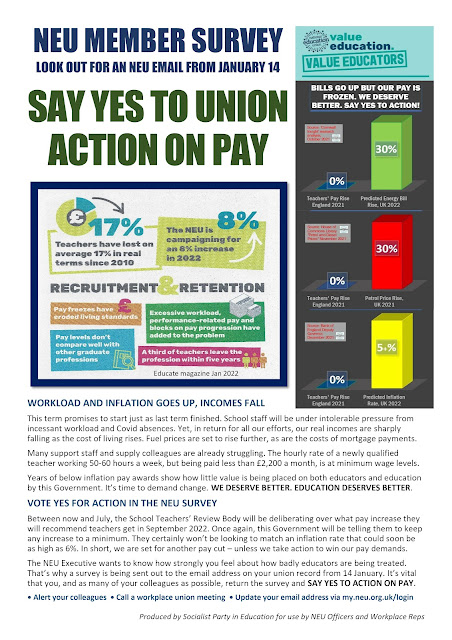
NEU Member Survey - say yes to action on pay

WORKLOAD AND INFLATION GOES UP, INCOMES FALL

This term promises to start just as last term finished. School staff will be under intolerable pressure from incessant workload and Covid absences. Yet, in return for all our efforts, our real incomes are sharply falling as the cost of living rises. Fuel prices are set to rise further, as are the costs of mortgage payments.

Many support staff and supply colleagues are already struggling. The hourly rate of a newly qualified teacher working 50-60 hours a week, but being paid less than £2,200 a month, is at minimum wage levels.

Years of below inflation pay awards show how little value is being placed on both educators and education by this Government. It’s time to demand change. WE DESERVE BETTER. EDUCATION DESERVES BETTER. 

VOTE YES FOR ACTION IN THE NEU SURVEY

Between now and July, the School Teachers’ Review Body will be deliberating over what pay increase they will recommend teachers get in September 2022. Once again, this Government will be telling them to keep any increase to a minimum. They certainly won’t be looking to match an inflation rate that could soon be as high as 6%. In short, we are set for another pay cut – unless we take action to win our pay demands.

The NEU Executive wants to know how strongly you feel about how badly educators are being treated. That’s why a survey is being sent out to the email address on your union record from 14 January. It’s vital that you, and as many of your colleagues as possible, return the survey and SAY YES TO ACTION ON PAY.

Download the flyer drafted by Socialist Party in Education for use by NEU Officers and Reps as a pdf, jpg or an editable word document from this folder

Tuesday, 14 December 2021

Agency Workers Regulations - Myth Busters

MYTH BUSTERS - What to say when you’re told you haven’t got a case … when you have!

Download these posts as A4 leaflets:
Myth Buster 1, and
Myth Buster 2:

MYTH ONE:

“Schools can pay agency teachers what they like because ‘pay portability’ no longer applies”

When an agency teacher starts to raise their rights to be paid ‘to scale’ after 12 weeks, under the Agency  Workers Regulations (AWR), they may well be told that they definitely haven’t got a case because ‘pay portability’ no longer   applies. That phrase refers to legislation that was removed from the School Teachers’ Pay & Conditions Document (STPCD) in 2013.

That worsening of the STPCD means that permanent teachers starting work at a new school are no longer automatically entitled to be paid at least at the same salary point that they were on in their previous job. Academies have always been allowed to operate outside the STPCD in any case. 

But none of this means that schools can automatically ignore the AWR and pay their agency teachers what they like after 12 weeks. 

What does official guidance say?

The main AWR guidance for hirers of agency workers is issued by the ‘BEIS’ Government Department. It says:

“Deciding what “equal treatment” means will usually be a matter of common sense – the requirement is simply to treat the worker as if he or she had been recruited directly to the same job”.

It also gives the following advice “where a hirer has pay scales or pay structures”:

“A hirer has various pay scales to cover its permanent workforce, including its production line. An agency worker is recruited on the production line and has several years’ relevant experience. However the agency worker is paid at  the bottom of the pay scale. Is this equal treatment?

Yes, if the hirer would have started that worker at the bottom of the pay scale if recruiting him or her directly. But if the worker’s experience would mean starting further up the pay scale if recruited directly, then that is the entitlement.

Starter grades which apply primarily, or exclusively, to agency workers may not be compliant if not applied generally to direct recruits.

In short, if a school says it will only pay an agency teacher at, say, an M1 rate, then it will need to show that it also recruits new permanent staff at M1 too.

Each case needs to be argued on the specific policy and/or practice in that school, not on the STPCD in general.

What does the school policy say?

In order to help recruitment, many schools have retained ‘pay portability’ in their pay policies, despite the changes made to the STPCD.

A clear cut way to show that an AWR claim is justified is to show that the school’s own pay policy states that ‘pay portability’ applies and/or that previous    experience is taken into account when recruiting new staff.  

Rush v Academics Ltd 3202251/2020

With the right advice, Jenna Rush, an agency teacher working in a Multi Academy Trust in Outer London, used the wording of  the Trust’s pay policy to successfully win her AWR claim.

Jenna was an experienced “post-threshold” teacher returning to work after a career break. She taught for most of the 2019/20 academic year at three primary schools run by the Arbor Trust. Her pay rate through ‘Academics Ltd’ agency was £140 a day, including holiday pay.

In April 2020, she found out about the AWR and queried her pay rate. The agency agreed to  adjust her pay, but only to the STPCD rate for  an M1 Outer London teacher - £145.41 a day. Jenna Rush argued that, under the AWR, after 12 weeks she should have been paid at the U1 daily rate for Outer London, £212.40.

She won! An Employment Tribunal ruled that:

“There is nothing in the Regulations that says that an agency worker, regardless of their skills and experience, should be treated as standing in the position of a newly qualified worker, once they have completed their 12 weeks employment. The question is what  was the Claimant’s entitlement, with all her skills and years of experience, had the Trust  recruited her directly for the post of qualified Primary Art Teacher”.

“Nothing in the evidence supports the position that her entitlement was to M1”

“The Trust’s policy states as follows: ‘The school is committed to the principle of pay portability and will apply this principle in   practice when making all new appointments’ ”

“It is this Tribunal’s judgment that [Ms Rush] is entitled to remedy for her successful complaint of unlawful deduction of wages. [She] should have been paid at U1 for the period 1 January 2020 until the date she left in July 2020. As she has already been paid at M1 level for that period, the Claimant is entitled to be paid the difference between M1 and U1”. 

What if the school policy isn’t clear? 

The Rush vs Academics Ltd claim was certainly helped by the Arbor Trust policy specifically  referring to ‘the principle of pay portability’. But what if the school pay policy isn’t that clear-cut? 

A Tribunal won’t just look at policy, it will also look at the actual practice being carried out in the school, Trust or Local Authority for setting the pay of newly appointed staff. The key question is always: ‘if the school had been recruiting the agency teacher directly, what pay point would they have been awarded?’

A school can’t assert that “we can pay you what we want” if an agency teacher can show that, in practice, when it recruits permanent staff, it does take experience into account and starts them at higher points on its pay scale. 

If they say it’s individually negotiated, then why hasn’t that taken place with agency teachers? As the Rush Tribunal states “[She] was entitled to have the benefit of a conversation with the [Agency] and the Trust at the 12 week mark as to what would have been the appropriate wage for her. She was denied that benefit”.

In practice, how many schools appoint all their new recruits to the bottom of their pay scale? Very few, if any, because they wouldn’t be able to recruit to their vacancies! However, the more evidence that can be provided to support the teacher’s case, the stronger the claim can be.

Useful evidence for the agency teacher and their trade union rep to gather can include:

School pay policy - even if it doesn’t mention ‘pay portability’ specifically, what does it say about how starting rates for new recruits are agreed? 

Adverts - from the school or the wider Trust/Local Authority that show appointments to permanent teaching posts are being made at higher points on the scale. (For example, Jenna Rush provided, as additional evidence, the advert the Trust used to recruit a new Art Teacher after she ceased working there. It included the full salary range from M1 – U3).

Evidence from other teachers - about what pay rates they were appointed to, about the practice in school for recognising experience.

***

MYTH TWO:

“Schools can pay agency teachers at lower rates because they don’t carry out a permanent teacher’s duties”

When an agency teacher starts to raise their rights to be paid ‘to scale’ after 12 weeks, under the Agency Workers Regulations (AWR), some schools and/or agencies will argue that they have no such right because a supply teacher doesn’t do ‘the same work’ as permanent teachers. These claims are excuses designed to keep down the costs of employing a qualified teacher and deny them their AWR rights.

The teacher - and their union rep - should stick to their guns and demand the pay to which they are entitled. 

What do some agencies say?

“If an agency worker has worked at your school for 12 weeks but only on a daily supply basis, it’s unlikely that AWR will be  applicable. The worker will invariably be undertaking a substantially different role each time they come to your school and should not, therefore, be   entitled to equality of pay under the AWR”. ‘PK Education’ website.

The example above, taken from one agency’s website, is typical of the kind of
arguments that are made. Whatever the exact words used, they all boil down to the same claim - that an agency teacher is carrying out a very different role to a permanent teacher, and so isn’t entitled to the same pay and conditions.

What does the law say?

Section 5 of the Agency Workers Regulations 2010 sets out how, after the qualifying period of 12 weeks, an agency worker is entitled to the same basic pay and conditions as they would have received if they had been recruited directly. 
In order to establish those entitlements, the Regulations refer to “a comparable employee … engaged in the same or broadly similar work”.

Of course, an agency teacher’s duties might not be exactly identical to those    of a permanent classroom teacher with, say, a tutor group. On the other hand, agency staff  have pressures on them that a permanent teacher doesn’t have to face, often having to learn and adapt at short notice to different systems operating in different assignments. 

Above all, the “broadly similar work” that both the directly recruited and agency teacher carry out is clear - it’s classroom teaching - and the agency teacher is entitled to be paid as such.

What about official guidance?

The main AWR guidance for hirers of agency workers is issued by the ‘BEIS’ Government Department. It says:

It is not necessary to look for a comparator. Deciding what “equal treatment” means will usually be a matter of common sense - the requirement is simply  to treat the worker as if he or she had been  recruited directly to the same job. 

Equal treatment … covers basic working and employment conditions. They are those which are ordinarily included in relevant contracts (or associated documents such as pay scales … ) of direct recruits”.

The pay and conditions that must be applied under the AWR are those that ordinarily apply in that school - i.e. the standard pay scales that apply to direct recruits. For agency teachers, the entitlement is to the teachers’ pay scales applying in that school.

What about “specified work” ? 

Some schools and agencies argue that agency teachers are not carrying out “specified work” so aren’t entitled to be paid as teachers. They may refer to this advice from the DfE guidance on the Agency Workers Regulations: 

Teaching Pupils. If the school asks a temporary work agency to provide a teacher    to carry out specified  work in a school and the person engaged to do the work is a qualified teacher they should be paid as a qualified teacher … “Specified work” means planning, preparing and delivering lessons and courses to pupils and assessing and reporting on the development, progress & attainment of pupils”. 

There’s nothing in this advice that implies that agency teachers shouldn’t be paid on teachers’ pay scales. Far from it. It is saying that, if you are a qualified teacher, and you “teach pupils”, you should indeed be paid as a qualified teacher.

The idea of “Specified Work” comes from the Education (Specified Work) Regulations first introduced in 2003 following the then Labour Government’s “Workforce Agreement” introducing the idea of “cover supervisors” to take on some short-term absence cover.

Many employers will have agreed pay scales for cover supervisors. But this is not the work carried out by someone engaged as an agency teacher and these are not the scales that should apply to them under the AWR.

“Actively Teaching”  

The official 'WAMG Cover Supervision Guidance' made clear how ‘cover  supervision’ differs from ‘active teaching’:

“Cover supervision occurs when no active teaching is taking place and involves the supervision of pre-set learning activities in the absence of    a teacher:

1. Supervising work that has been set in accordance with the school policy

2. Managing the behaviour of pupils whilst they are undertaking this work to ensure a constructive environment

3. Responding to any questions from pupils about process and procedures

4. Dealing with any immediate problems or emergencies according to the school’s policies and procedures

5. Collecting any completed work after the lesson and returning it to the  appropriate teacher

6. Reporting back as appropriate using the school’s agreed referral procedures on the behaviour of pupils during the class, and any issues arising.”

An agency teacher is hired to ensure that far more than ‘supervision’, only responding to questions ‘about process’, is taking place. 

As a qualified teacher, they will be ‘actively teaching’, answering questions about ideas, explaining concepts, delivering lessons, assessing progress. They will indeed be carrying out activities that constitute “specified work” under the Regulations. 

To qualify for the AWR, the agency teacher will have been working on an assignment for over 12 weeks. Of course they will have been planning and preparing in order to be able to carry out their teaching work.  Yes, they may  be drawing on plans and resources provided to them, but that is simply recommended practice to reduce unnecessary workload.

Assert your rights to equal treatment!