Monday, 1 February 2021

Don't draw the wrong conclusion from ONS data - do not rush to fully open schools

Once again, staff and parents have been angered at the way ONS statistics are being erroneously used, by politicians and press alike, to push for schools to fully reopen before it's safe to do so.

The figures under debate are statistics comparing Covid-19 related deaths by occupation, released by the Office for National Statistics on 25 January. One of its findings, according to the ONS, is that deaths of those working "as teaching and educational professionals, such as secondary school teachers, were not statistically significantly raised when compared with the rates seen in the population among those of the same age and sex". 

But that conclusion, jumped on by the BBC and others as evidence of 'school safety' is not as straightforward a 'fact' as it might seem. It certainly doesn't seem to sit easily alongside other ONS data that consistently showed that infection rates amongst school-aged children were the highest of all age groups at the end of last year. Or are school staff somehow magically immune from infection and death?

Leaving out support staff

Looking through the full statistical download from the ONS myself, even their headline figure of "139 deaths involving the coronavirus (COVID-19) in teaching and educational professionals aged 20 to 64 years" underestimates the overall loss of education staff.  

Firstly, figures for support staff are left out. I have added in the categories I could find in the overall tables, although there may be additional numbers subsumed under other headings such as 'cleaners'. That sadly increases the total to 221 overall. 

Secondly, the data excludes deaths to those who were aged 65 and over. Now, while these additional numbers may include school staff who have retired, it is also quite possible that some serving school staff are included in these figures too.

Drawing unreliable conclusions

While, as a teacher, I understand the need to include all school staff in an analysis of education deaths, I make no claim to be a statistician. However, mathematician Sarah Rasmussen has also cast her critical eye over the ONS occupation data. As she points out in a revealing Twitter thread, to arrive at the right conclusion, you need to ask the right question - and you also need to be aware of the limitations and context of the dataset you are looking at.

Importantly, she points out that "60% of covid deaths in this survey are from 9 Mar - 25 May" - a period when, of course, most schools weren't fully open. The delay from infection to registration of death will also mean that deaths linked to the last weeks of term leading up to Xmas, when school infections were rising most sharply, are also excluded from the data. It probably excludes most deaths resulting from new variants too. So this is NOT a dataset that can be used to make conclusions about the safety of fully opening schools in Spring 2021.

Sarah Rasmussen also points out that, given the small numbers of staff counted in each subdivided category, reliable conclusions cannot be drawn from the ONS data. The ONS analysis itself stated that "it was only possible to calculate a reliable rate for secondary education teaching professionals", where they concluded that rates of death "were not significantly different than those of the same age and sex in the wider population". However Sarah also questions that conclusion too.

A fair comparison can't be made between different occupations over such a wide age group, without considering the specific make-up of each occupational group. School staff are largely female. Teachers, in particular, are also often young. Therefore, for the same rate of infection, fewer deaths might be expected than compared to a profession with an older male demographic.

An alternative analysis gives different conclusions

Sarah Rasmussuen therefore argues that a better analysis of risk would be to compare the ratio of covid deaths to deaths by all causes for each occupation over the same time period. 
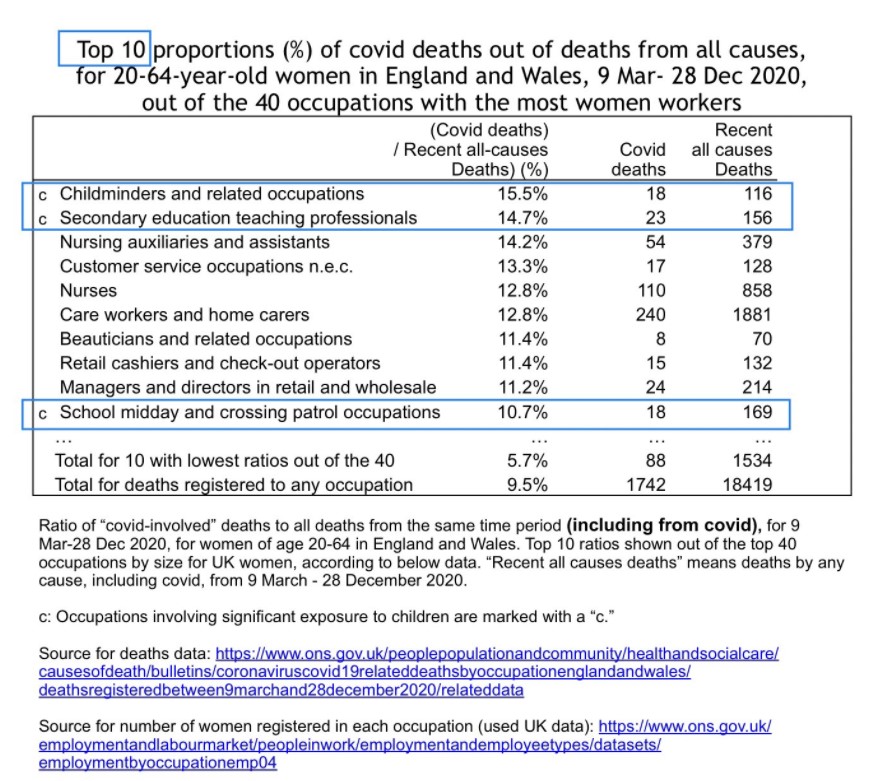

When that comparison is made using data for women , the grim ranking puts childminders first - but secondary school teachers second. This is also her finding when she ranks data using a measure called "Age Standardised Death Rates".


Other comparisons give slightly different rankings. For example, Sarah's analysis based on 'excess deaths' relative to previous years sees teaching assistants ranked highly. 
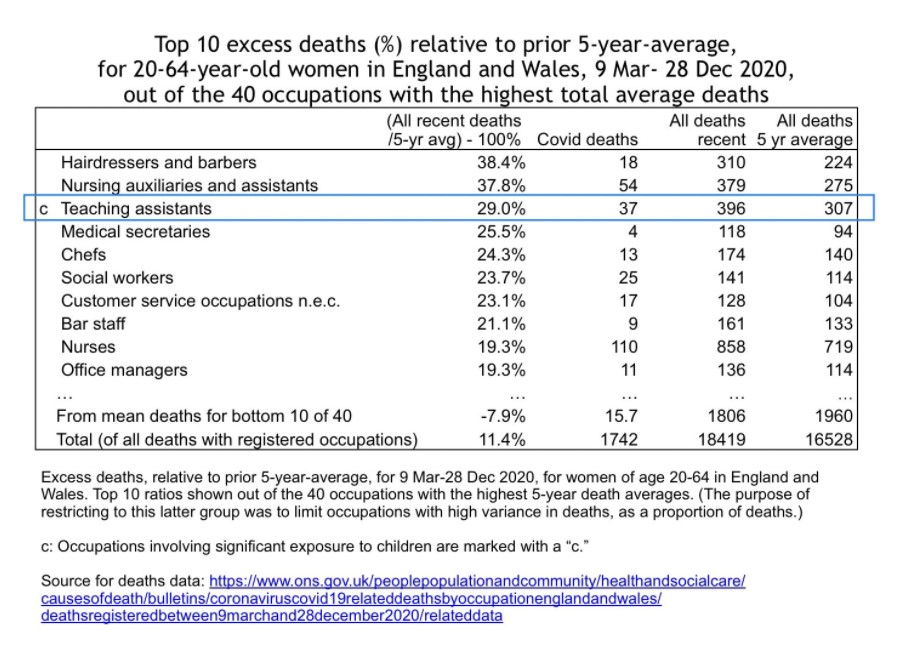

She also points out that, owing to a delayed rise in primary student infection, primary death counts may not have been so impacted until after the period that the ONS data covers. But school staff absence data shows that, in November and December, primary school teachers had nearly the same rates as secondary colleagues. Sadly, the resulting death rates are therefore also likely to be similar too.

Either way, these are very different conclusions to those drawn by the ONS.

No justification for fully opening schools

Sarah Rasmussen's analysis confirms that the ONS occupation comparisons data gives no justification for arguing that it is safe to now push ahead with fully opening schools. 

For a start, the data is based on a period when schools were largely only partially open. Her analysis also shows that the conclusions drawn by the ONS on the risks to school staff are highly debatable.

But, of course, the NEU's insistence on school and college safety isn't just about our members, it's about the communities that we serve. Yes, fully opening schools while infection rates are still so high would result in further staff deaths but it would also result in many more infections and deaths in the wider community too. The growing concerns over 'Long Covid' will be an additional concern for staff and parents alike.

Just to take one last piece of data, politicians should study the data being provided by Public Health England on Covid outbreaks that are still ongoing in school settings. Yes, thanks to the U-turn forced on the Government by the NEU's insistence that our members would not return to unsafe workplaces, the numbers of outbreaks in schools has thankfully declined. But look more carefully. In SEN and Nursery settings - the places where Headteachers are being put under immense pressure to remain open to as many students as possible, the numbers of outbreaks are rising.

If schools are fully opened now, this will be the dangerous outcome across all settings. Once again, schools will act as the "vectors for transmission" that even the Prime Minister acknowledged had occurred with the new variant.

So let's insist politicians draw the right conclusion - keep school numbers at a safe level and keep our schools and communities safe. 

Friday, 29 January 2021

Questions to a DGS candidate - Union Democracy, School Safety, Honoraria, Facility Time, International Solidarity.

Quite rightly, once you have declared as a candidate for as important a post as Deputy General Secretary, members and District Officers want to know where you stand on the issues that matter to them. 

I am always happy to be asked, and always happy to give my opinion, even when the questions are on subjects that I know divide opinion within the Union. Further, in order to be transparent, I will use my blog to share my responses for anyone to read.

For a union where members are ‘listened to’, not just ‘talked at'.

I have been asked to comment on a range of different areas this week. The two areas to which I have given the most detailed responses - the 'Help a Child to Learn' appeal (see my separate post) and the limits on 'Honoraria' payable to Local Officers - may seem unconnected. However, the controversy around both issues contains a common element, and that is a worrying lack of prior consultation from the top of the Union.

As I have written below, one of the reasons that I am standing as DGS is to be a voice at Union HQ that will seek to counter a growing tendency to centralise and  impose policy from the top, without sufficiently consulting local activists and listening to the concerns of members in the workplaces. As I have put on my initial campaign leaflet, I stand for a genuinely democratic  union – where members are ‘listened to’, not just ‘talked at’.

That's certainly not to say that, as DGS, I would not be working fully with others as part of the HQ team - indeed, I think I am the candidate who will best strengthen that team. HQ colleagues already know from my work as a National Executive member, and then London Regional Secretary, that I work well with others, staff and local officers, in a leadership role. However, a leadership also needs voices that will not be afraid to question decisions, and to reflect on criticisms that have been raised, when it is necessary to do so. Without those voices being heard, mistakes will be made - as the last week has shown.

School and College Safety - we can't leave room for risk

Following the 'Help a Child to Learn' announcement, the Union yesterday released an updated "Education Recovery Plan". There's much within it that will gain wide support from NEU members - such as the call for a 'recovery curriculum', an end to child poverty, guaranteed access to broadband and laptops and increased staffing budgets to employ additional supply teachers and others in schools and colleges.

However, once again the plan seems to have been released without sufficient prior consultation with the National Executive and others such as the Health and Safety Organising Forum. If that had happened, once again weaknesses could have been addressed in advance of a Union announcement.

In particular, the section of the Recovery Plan on Safety in our Schools and Colleges lacks the detailed clarity that was rightly included in the recently released joint union checklist for 'partial opening'. A call simply to 'limit' numbers and bubble sizes and to call for 'arrangements for distancing' is insufficient to protect staff, students and our communities. Unless we make specific demands - such as the call in the checklist for schools to be operating at a maximum 15% of normal capacity at present - a dangerous return to fully open schools will be much harder to resist.

The Recovery Plan does, however, rightly add a footnote to page 9 of the Government's 'Children's Task and Finish Group' paper of 17 December 2020. That summary provides the answer to the false claims now recirculating again that schools are not, after all, "vectors for transmission".

It confirms, for example, that school-aged children "are more likely to bring the virus into the household than those aged 17+" and that "young people (aged 2-16) are much more likely than those aged 17+ to be the first case in their household". Surely, it must be obvious  - at least to those looking with their eyes open - that fully open schools were the places where those young people were most likely to have contracted that infection!

For our own sake, and for the safety of our families and communities, we must not compromise on insisting on a genuinely safe working environment in schools and colleges.

Honoraria - my reply to questions asked by Districts:

I was a Local Secretary for Lewisham NUT for many years and, as with many NUT Associations, there was a long-standing practice that a small honorarium was awarded to a small number of officers as a token of the work that they had done for the union over the year. 

I appreciate that some Associations did not support the practice, and, in a very few cases, there may also have been highly questionable uses of honoraria with large sums being paid to certain officers without  real democratic oversight from the members of the Association. However, Local Associations were given autonomy and trusted to make their own decisions.

I am sure we would all agree that nobody should be pursuing Union office for personal financial gain. That’s one of the reasons why I have pledged that, if elected as DGS, I will not accept more than a teacher’s salary for carrying out my role. But, equally, no one should be out of pocket for undertaking trade union work and, for example, necessary expenses and caring costs should always be met to ensure nobody is excluded from doing so.

I can appreciate that, on developing the National Education Union as a new organisation, past practices needed to be examined and critiqued. However, I am concerned that the way that limits to payment of honoraria have been agreed by the NEU Executive are one example of a growing top-down centralising tendency within the union that, as DGS, I would seek to counter. I fear that the changes to honoraria have also been drafted by HQ staff and National Officers who do not all have first-hand experience of the hard work required to build a Local District, nor of the hard-working volunteers who carry it out. 

Such important decisions should not be taken without full consultation and appreciation of the difficult and different circumstances that face different Districts, particularly those where facility time has been limited and the pressures of workload on colleagues mean it is difficult to recruit and sustain local officers.  Yet I understand that the Executive has now agreed further limits to the payment of honoraria, again without having considered the impact it could have on Districts such as yours.

A “lay-led Union” cannot just be a slogan. The National Union needs to make sure it is the reality.

In summary, my view would therefore be that:

Honoraria should never be paid in a way that can be seen as Local Officers simply voting for each other to be paid additional income without democratic oversight. As should always have been the case, honoraria should be subject to approval at a quorate AGM, publicised fully in advance.

In Districts where the union has been successful in maintaining facility time, and where most officers continue therefore to be released for trade union duties on their existing salary, any honoraria, if agreed to democratically by the District AGM, should only be a token additional amount. There will be other officers, including those who carry out trade union activities as well, that could, as now, also be eligible.

In Districts where employers are refusing to honour our entitlement to reasonable paid time off to carry out trade union duties, and it is felt that the payment of larger honoraria is required to assist the recruitment and retention of local officers, then this should continue to be payable, subject to the agreement of the District AGM, up to the existing limit of £2,000 per annum.

Where Districts feel that they are unable to operate without payment of honoraria that exceed these limits, then there should be full consultation with the local Executive members and Regional Office about what support can be given to the District to secure sufficient facility time and to recruit more workplace reps and Local Officers. If, as a result of those discussions, it is clear that additional honoraria are required as a temporary measure, then that should be agreed by the Union.

I do not support any stipulation that honoraria can never be paid to those who are carrying out trade union duties, such as retired caseworkers. Of course, it would be preferable if casework could be carried out by serving NEU members released on their existing salaries from their posts for the 'reasonable time' needed to carry out our trade union duties. This is, sadly, a legal right which is being denied us by far too many employers and which we need to pursue more vigorously as a Union. But where this is not the case, and others are having to take on those duties without paid release, it is self-defeating to impose an inflexible ruling that threatens to undermine the work of the Union at a local level.

Facility Time

A related question, that I have also been asked, is about my views on the strategies that the Union has been following over recent years to oppose the attacks that have been made on 'local facility time' by successive Conservative governments. 

Many Academy Chains and Local Authorities have sought to cut the budget used to pay the costs of releasing trade union officials for carrying out their duties. At the same time, the pressure and demands on members, and therefore on the Local Officers who support them, is growing ever greater. The need for a successful strategy to defend - and indeed, increase  - facility time is therefore pressing.

The approach taken by the Union, of employing additional organising staff, hasn't been the main problem. The Union can certainly benefit from having an organising team, just as long as as there are clear organising goals and strategies, the organisers themselves are confident in what they are doing, and they are deployed as part of an agreed overall plan that is being worked on together by both Local Districts and Regional & National staff. Unfortunately, that has not been the case.

As DGS, I would call for an urgent review of our approach to defending facility time, particularly listening to the experiences of both Local Officers and the organisers themselves. I would propose we place a greater emphasis on our legal rights as a recognised trade union. We need to insist that our representatives have a right to reasonable paid time off to carry out union duties and undertake training, and that employers need to find the budget to allow the law to be followed. 

At the same time, the Union needs to explain to members why our legal rights have to be defended. We need to go back to basics and make sure that members appreciate that many of the officers they call on for help are volunteers, teachers and support staff like themselves, released from work part-time to carry out union duties, not paid officials. We have to campaign and organise members to insist that their employers honour those rights, including through taking industrial action if necessary. 

International Solidarity

Finally, I was asked my views on the repression of the Uighurs by the Chinese regime. I replied to say that, as a Union, we should certainly add our voices to those rightly speaking out against the persecution of the Uighurs and the mass detention and repression in Xinjiang. In showing solidarity, we should also help workers across China build a united opposition to its dictatorial regime and the inequality over which it presides. 

Suffice to say, we obviously also need to distinguish our trade union solidarity from governments whose 'support' to national struggles too often comes only as a calculated part of their foreign policy, empty words designed to weaken their international competitors, rather than being a genuine offer of support to the struggles of people to free themselves from poverty and oppression. 

Wednesday, 27 January 2021

The Help a Child to Learn "Big Announcement" - lessons need to be learned

Yesterday, thousands of NEU members tuned in to listen for the surprise “Big Announcement” that they had been told to expect from their Union. 

Expectations had been raised, not least that this might be another morale-boosting call from the top of the Union to build the collective action needed to defend school and community safety. It was, after all, taking place on the grim day when the official UK Covid death toll had exceeded 100,000.  

The news that this was actually about a £1 million donation from the NEU to launch the “Help a Child to Learn” appeal, has had quite a mixed reception. Some lessons certainly need to be learned for the future. 

The Mirror's headline - "We launch fund"

Every NEU member will share the Union’s determination to tackle child poverty, will be angry at the government’s failure to support children and families working at home during lockdown, and will want to make sure that those hurt most by those failures are not left without the resources they need.

But a decision to spend £1 million should not be launched on members as if they were just part of an audience to a publicity stunt. Prior consultation should have taken place through our union structures. If that had happened, then mistakes could have been avoided.

Firstly, if the Union had explained that we had made savings in our planned budget, and consulted over how that might be spent, then other priorities might have been considered. If it’s about the welfare of those hit by the pandemic, additional support for supply colleagues left without employment is, for example, another pressing need. 

Emails asking members to donate to the appeal themselves also need to recognise that some recipients will also be struggling to pay their rents and bills. Members and their families have also been hit by the pay freeze, job cuts and furlough. Many staff already keep schools going not just through too many hours of unpaid work, but also by classroom resources and supplies being paid for out of their own pockets as well.

Additional funds could have been prioritised for supporting Districts in organising the campaigns and industrial action needed to win both our Education Recovery Plan and NEU demands to defend safety and workload. After all, a Union is, first and foremost, an organisation that uses its collective strength to insist the government changes its damaging policies, rather than having to step in to substitute for those failures. The strength of Marcus Rashford’s campaign wasn’t that he used his wealth to pay for school meals but that he pressurised the government to act.

The NEU’s Education Recovery Plan’s call for internet access, free laptops, additional spaces and staffing to allow education to take place in safe environments, and for free school meals throughout the holidays are all vital – and should have had far greater billing yesterday. But we should go further. What about demanding free broadband, for the scrapping of universal credit and its replacement with benefits that reflect the true cost of living? For investment in the building of council homes, education and the health service? What about pointing out where the real wealth in society is to be found and how it should be used to benefit the majority, not hoarded by a wealthy minority at our expense?

Nevertheless, given the dire circumstances school staff know exist in our communities, many members will recognise that, alongside our main role of demanding change, we may also have to step in and try and meet some of those urgent needs ourselves. However, if that's felt to be necessary, then why would a Union do so through a partnership with the Daily Mirror and a major office supplies company, Viking?

The Daily Mirror has certainly not been a consistent supporter of the Union’s demands for school safety. It also appears funds are going to be allocated to schools in stepped £500 packages “to enable them to purchase the stationery needed for learning at home” – through Viking presumably. 

This is not how union funds should be allocated. We should be linking up with schools and local authorities, with food banks and other local organisations who understand pressing local needs and who can build a real network of solidarity, rather than funds being managed through an office supplies company!

NEU donations to support emergency social solidarity must be built alongside a clear campaign to demand the Government acts to deliver the funding and policies really needed to address inequality – and that is the priority for our Union.

Sadly, the “Big Announcement” has been packaged more like a PR exercise. Unions don’t build mass backing through PR, but, first and foremost, by boldly explaining their demands to their members, to other trade unionists and to the communities they serve. That’s how the NEU must build its support - and how we can work together to win real and lasting change.

Monday, 18 January 2021

Take Action to ‘Insist on the Checklist’ - and to ‘Make Early Years Safe’

#InsistontheChecklist

The determined stance taken by thousands of NEU members at the start of term in refusing to return to an unsafe workplace helped ensure that most schools are now only open to reduced numbers.

However, too many classrooms remain dangerously full. Too many schools are making unreasonable expectations. That’s why it’s vital that NEU members continue to use their collective strength to protect the safety and welfare of staff and our school communities.

Every school group immediately needs to read the new ‘checklist for partial opening’ that was issued on Friday by the GMB, NEU, Unison and UNITE. It contains vital guidance to union members to make sure that schools are as safe environments as they can be, particularly given the greater transmissibility of the new Covid variant. I have produced an A4 poster summarising the key points.

NEU Districts are reporting on gains that have already been made by keeping up the pressure on Local Authorities, e.g. reversing unsafe Lateral Flow Testing isolation protocols.

Enormous pressures are being put on Heads to take in greater numbers of keyworker and vulnerable pupils than safe distancing and ventilation requirements allow.  We must “insist on the checklist” to protect the health and safety of our colleagues, our students, and our school communities.

“We are strongest when we act collectively”

As the message from the NEU General Secretaries makes clear, the union “will back every workplace group that feels the need to take action”. Their guidance recommends the following steps are put into place as quickly as possible:

* Speak with members at an online meeting and see if they share common concerns.

* Arrange a meeting with your head and/or SLT to raise concerns.

* Report back on the response from leadership and discuss next steps with members, including escalation and further support.

* Escalate concerns with your branch and seek more support.

Two forms of action are mentioned in the guidance:

1) Moving quickly towards a ballot for industrial action.

* Trade union legislation means that the legal ballot process takes a few weeks, and a mandate for action also requires a good turnout in a postal ballot.

* To avoid delays, reps should check their membership lists immediately. Make sure the Union has an accurate list of your current membership and home addresses are correct for a postal ballot.

2) The union will support members' use of ‘section 44’

* Ask the Union for advice so that section 44 letters can be tailored to your school circumstances.

A national ballot as a safeguard against an unsafe return 

As the New Year U-turn showed, we can make gains when we stand together across a workplace, or a group of workplaces, but we are even stronger when we act together as a whole union.

With the NHS still under huge pressure, none of us knows how long this period of ‘partial reopening’ will need to last. But it’s clear that the Government want to try and fully open schools as soon as they can. We must again make clear that full opening must be “Only When It’s Safe” to do so.  I believe that launching a ballot for national action now could help make sure we have the safeguard of an action mandate in place where it might be needed to oppose an unsafe return.

***

Reports I have received from around the country indicate there are some particular threats ongoing at present. These include:

Make Early Years Safe

Nursery classes are being bullied to stay fully open under the threat of financial penalties. In at least two London boroughs today, Heads that had implemented rotas of safer, smaller, numbers of children have been told that they must open fully or lose income for the places they do not believe that they can safely fill at the present time. Schools in other areas have had similar threats.

This is both outrageous and dangerous. As the NEU’s #MakeEarlyYearsSafe model letters, calling for emergency funding to be immediately provided to cover additional Covid costs, explained to MPs:

* Anthony Costello, SAGE member and UCL professor of global health and former WHO director, said in The Mirror on 9 January: “We are in a national crisis with a pandemic out of control. We should have no nurseries open.”

* Case rates for nursery-aged children in England are in line with those for primary aged children –216/100,000 in the 0-5 age group, and 236/100,000 in the 5-9 age group.

We need to give confidence to members in Early Years to stand up to these threats. Make sure to identify the members teaching in Nursery Classes in your school lists and build for urgent action.

Supply Teachers

As in the first lockdown, the damage caused by the privatisation of most supply teaching has left many agency staff at severe financial risk. Too many agencies will not even agree to furlough.

Schools should not be looking to save money at the expense of supply teachers, especially not those where a long-term engagement had previously been agreed. The needs are still there to be met. DfE guidance now confirms that agency staff can be used for remote, as well as face-to-face, teaching.

The Supply Teacher Network has produced a Supply Educators' Survival Kit to support colleagues.

Support Staff

Support staff are under some of the greatest pressures at present. Firstly, some schools are operating rotas that insist support staff are in schools all the time while teachers are more likely to be allowed to work from home. We must insist on equality of treatment.

The new joint union checklist includes some important points in defence of support staff colleagues. One of these is the statement that “systems should be in place to ensure a fair balance across the whole staff in respect of working from home and working on site”.

Reports are also coming in of schools using the lockdown as an opportunity to launch restructuring proposals where support staff jobs appear to be particularly at threat. Collective action will be needed to oppose cuts and to defend education and jobs.

Workload and Monitoring

Sadly, while many schools recognise the difficult and stressful circumstances in which educators and pupils are working, some poor managers still seem to be unable to prevent themselves putting staff under unacceptable pressures through unreasonable workload demands and/or by insisting on inappropriate monitoring of online learning. Once again, a collective response is the best way to back up our entirely reasonable demands that good managers support, not bully, their colleagues.


Wednesday, 13 January 2021

Why consenting to LFT tests instead of self-isolation risks making matters even worse

Given the worryingly high infection rates in England, the advice being issued via the Government/NHS Test & Trace "Schools and Colleges Handbook" is of real concern.

The advice contained within the Handbook risks turning Lateral Flow Testing (LFT) into a mechanism that helps to increase transmission rates instead of cutting them. 

This is because the guidance clearly suggests, to both staff and students, that - as long as they give consent - they would be able to continue to attend school, rather than self-isolate, if they are found to be a close contact of a positive case. Instead, they would take daily LFT tests as an alternative to make sure that they remain 'negative'.

Advice for parents and pupils within the Handbook

Such a suggestion would have obvious attractions to staff and parents as it appears to provide a safe way to ensure teaching and learning is not disrupted. But it is absolutely NOT a safe proposal and I would strongly advise that such consent should NOT be given. Any member of staff pressurised to do so should seek urgent Union advice.

Yes, the LFT tests can be useful to detect additional asymptomatic positive cases that might otherwise have gone unnoticed but they are absolutely not reliable enough to be used as an alternative to isolation. 

Here's the latest advice from the British Medical Journal, explaining why not:

" The rapid test kits most widely used in UK universities, schools, and care homes were shown to detect just 48.89% of covid-19 infections in people without symptoms when compared with a polymerase chain reaction (PCR) test."

" Independent Sage said testing should be used as a means of 'finding cases rather than as a means of determining whether or not people are infected, given the high negative rates' "

A negative test should not be taken as an indication that someone is not infected or to relax other mitigations at either an individual or collective level ".

Testing should be preceded by a clear information campaign to make sure people understood that a negative test 'does not mean you don’t have covid'.” 

A damning BMJ opinion piece, published yesterday by three Public Health experts, is also posted here. It calls on the government "at least to pause the rollout of rapid asymptomatic testing using the Innova test, including its use in care homes, schools, communities and self-testing by untrained people at home, until clearer messaging on the risks of negative results can be developed".

Some employers have recognised the significant concerns about reliability. For example, I understand that Coventry Council has confirmed that this is now their position today after discussions with the NEU locally. These employers are, correctly, not proposing that LFT tests are used as an alternative to isolation but as an additional tool whilst maintaining other safety measures and isolation protocols. However, this is not the case in all areas.

The current Government model consent form found here clearly states under point 11 that "I consent that if a close contact of my child tests positive but I / my child has tested negative, I / they will continue to attend school / college but will be tested every day at school / college for 7 days".

Advice for staff within the Handbook

Current NEU advice (issued 08/01/21) can be found here. it stresses the logistical concerns about introducing testing rather than the reliability issues. However, it does clearly state that:

* Where pressure is applied, NEU members should respond collectively to the head teacher/principal and seek the support of the branch/district secretary if necessary.

UPDATE (13/01/21) - the NEU advice has been strengthened and now also states that:

* Members should not be expected to sign consent forms accepting that they do not isolate in these circumstances 

* The NEU advises that members who are the contact of a positive case should not participate in serial testing and should instead self-isolate in accordance with Government guidelines.

UPDATE (2) (14/01/21) - In a move that confirms the concern amongst medical professionals at the inappropriate use by the Government of Lateral Flow Testing, the Guardian has reported tonight that the Medicines and Healthcare products Regulatory Agency (MHRA) has told Ministers that they have NOT authorised the daily use of tests due to their concerns, as outlined above, 'that they give people false reassurance if they test negative'. 

UPDATE (3) (15/01/21) In response to Government insistence that they had received regulatory authorisation, Schools Week has published a MHRA statement making clear that this is NOT the case. The report suggests that the authorisation that was granted was solely “to be used to detect cases, but they have not approved it to be used as to do what they call ‘test to enable’ which is this testing to let children stay in class.”

UPDATE (4) (20/01/21) - Gavin Williamson forced to concede another U-turn!

“NHS Test and Trace and Public Health England have reviewed their advice, and concluded that in light of the higher prevalence and rates of transmission of the new variant, further evaluation work is required to make sure it is achieving its aim of breaking chains of transmission and reducing cases of the virus in the community.

“We are therefore pausing daily contact testing in all but a small number of secondary schools and colleges, where it will continue alongside detailed evaluation.”

Monday, 11 January 2021

Act together to oppose unsafe numbers and rising workload

SCHOOL STAFF SHOULD TAKE CONFIDENCE from how our mass refusal to accept unsafe working conditions forced the Government into a much-needed U-turn after only one day of the new school term. 

Only 24 hours earlier, Boris Johnson was claiming schools were safe. He was then forced to admit that schools act as "vectors for transmission" of the virus after all - something that we all knew months ago. The announcement of the cancellation of SATs, GCSE and 'A'-levels soon followed too.

We should learn important lessons from how we were able to succeed by acting together to assert our legal rights to a safe workplace through "Section 44". We achieved more in a few days than petitions and letter writing to Ministers had achieved in months. 

The unions’ work is far from over

Any celebrations over the U-turn have sadly only been short-lived! It soon became clear that schools aren’t really ‘closed’ at all.

Everyone is working under highly stressful conditions.  Workload is rising. The threat of Ofsted monitoring is being raised again. Too many schools are making unreasonable expectations, particularly over online learning. Some have told staff they have to attend work every day, even though the lockdown regulations say that "everybody should work from home where possible". 

Support staff have been under particular pressure. They should be included on rotas to support learning from home too.

Above all, too many classrooms remain dangerously full. The definition of 'critical workers' has been applied far too widely. Nursery classes have been told they must remain fully open. Special schools have also been under pressure to accept every pupil.

Keeping schools open to such high numbers has nothing to do with keeping children safe. Instead, it means packed classrooms will continue to spread the new variant. 

It is putting more lives in danger and more pressure on an overwhelmed NHS. We have to insist that numbers in classrooms are cut back.

We recognise the pressure on our school communities. Children need more resources at home and parents/carers should be eligible for full pay when they have to stay at home to provide childcare. But we can't let government failures be used to browbeat us into accepting unsafe working conditions.

Look at the data. The UK situation is stark. Unless we remain firm, infections and deaths will continue to rise. That is of no help to anyone.

The NEU and other unions urgently need to agree a set of minimum conditions for school safety and take the action necessary to make sure that they are met.

UPDATE 15.01.21 - The NEU and three other education unions have released a new strengthened 'checklist for partial opening'. I have produced an A4 summary of the key points in the checklist:

Download the A4 poster from: https://bit.ly/35JfOQk


Tuesday, 5 January 2021

Staff and unions force Johnson's hand over school safety

As the rapid retreat over the exams fiasco in the summer showed, this has long been a government that could be forced to U-turn once pressure was applied. Events over the last 24 hours have again shown just what can be achieved when a lead is given.

In the face of trade union pressure, as well as the ever-growing health crisis, Boris Johnson was forced to shift from his dangerous insistence that "schools are safe" into admitting that they were in fact "vectors for transmission" of the virus after all!

Some of the details of the announcements still make little sense. For example, why have Early Years settings been told they should remain fully open and why are BTEC vocational exams still going ahead in the coming week? This lot can't even handle their U-turns competently!

The battle for health, safety and welfare in both our schools and our wider communities is still far from over. The NEU must remain on the front foot, not lapse back again into reliance on letter writing and lobbying alone. The intense activity and organisation of union members, reps and officers over the last few days achieved far more for school safety than months of hopeful appeals for Ministers to 'see sense'.

We have to make sure that schools operate safely for staff that are still on site and the priority learners that will be taught face-to-face; that staff are able to resist unacceptable workload demands around online learning; that learners at home get the laptops and other help they need; and that parents and carers are paid when they need to be at home for childcare reasons.

But, overall, we can be proud that we have helped to push the government back and have made sure our communities are a little safer at least!

Here is an interview I gave to RT tonight on their main news broadcast about what still needs to be put in place to support parents, staff and students.